A good trip can start with one clear choice: a city, a stretch of coast or a landscape we have wanted to see for years. The Grand Canyon alone runs 277 miles, a striking reminder of how much variety one country holds. The United States has city breaks, protected nature, quiet islands and places shaped by deep cultural roots. We can also look beyond its borders for a journey that feels new.
A bucket list is a personal list of destinations or experiences someone hopes to visit or complete. It can hold a famous landmark, a quiet coastal town or a long-planned adventure. Choosing one place matters because our time, budget and energy are limited. A thoughtful choice gives us room to enjoy a trip instead of racing through it.
These picks offer a starting point, not a rulebook. We can use them to find a trip that suits how we like to travel, whether we want busy streets or open views. Use the picks as inspiration, then match one to the time and travel style we actually have.
Key Takeaways
- Start with the experience we want most, such as food, history or nature.
- New York City, the Grand Canyon and Yellowstone lead the U.S. shortlist.
- Choose a national park gateway and a manageable area to explore.
- Check local access, road conditions and seasonal services before we go.
- Match each destination to our trip length and travel style.
- Keep a backup plan for weather-sensitive outdoor activities.
How Did We Choose the Best Places to Visit?
Our strongest U.S. picks pair a memorable setting with a clear reason to go, from New York City’s neighborhoods to the Grand Canyon’s scale. New York City, the Grand Canyon, Yellowstone, the Pacific Coast Highway and New Orleans lead this shortlist. Each offers a different kind of travel experience.
The United States has 50 states, so a useful list needs range. We chose cities, national parks, coastlines and cultural regions that can each support a rewarding trip. This is an editorial shortlist, not a ranked contest or a measure of which destination is objectively best.
We looked for places with a distinct sense of place and more than one way to spend time. A strong destination can give us a clear main activity while still offering room to adapt. One traveler may want museums and neighborhood meals; another may want a trail, a road or a quiet shoreline.
Choose a destination by the experience we want, not by a rank alone. Visitor preferences and access can change what makes a place a good fit.
Popularity can help us spot familiar landmarks, but it does not tell us whether a trip will suit our pace or interests. A well-known site may need more planning than a less famous town. A remote area may reward a long stay but feel rushed on a short visit.
Our picks aim to spark travel ideas across the country and beyond. They are meant to help us build a shortlist, not to settle every question about where to go. Choose the destination by the experience we want, not by a rank alone.
Which U.S. Cities Make the Best First City Breaks?
New York City is our most flexible first city break if we want iconic sights alongside neighborhoods, food and easy side trips. It offers the widest mix of city experiences among these three choices. Chicago suits architecture fans, while New Orleans brings music and regional food to the fore.
For a short visit, plan around neighborhoods instead of trying to cover an entire city. Each city rewards a different pace and focus. New York’s scale and energy can also tire travelers who prefer a slower trip.
New York City for a high-energy first visit
New York City gives first-time visitors museums, food, theater and distinct neighborhoods within one trip. We can spend a day in Manhattan, then explore Brooklyn or Queens without treating the city as one giant attraction. The best plan leaves time to sit down and enjoy a meal.
The city also works as a base for side trips to the Hudson Valley or the Hamptons. Those outings add a change of pace, though they need time beyond the main city visit. If we want a quieter break, New York may feel intense rather than relaxing.
Chicago for architecture and lakefront views
Chicago stands out for its architecture and access to Lake Michigan. The Riverwalk offers a close look at the city’s buildings from the water’s edge, and the Wrigley Building is a landmark along the river. A walk or boat tour can make the city’s design easier to read.
Chicago’s neighborhoods add food and local character beyond the central sights. We can keep the trip focused on one area each day, with lakefront time as a welcome pause. It is a strong choice when buildings and city planning are part of the fun.
New Orleans for music, food and local character
New Orleans offers a distinct mix of live music, local food and lively streets. We can hear jazz, sample regional dishes and explore neighborhoods with their own feel. A visit works best when we leave space for the city’s everyday rhythms.
These cities make different promises, so there is no need to race between them on one trip. For a shorter visit, pick one or two neighborhoods each day rather than crossing the city repeatedly.
Where Can We Pair U.S. History With Memorable Landmarks?
Washington, D.C. is the easiest starting point for a history trip because major monuments and museums cluster around the National Mall. The Lincoln Memorial gives the visit a clear civic focus. Philadelphia and Boston offer walkable links to the nation’s founding era.
Washington, D.C. works especially well when we want several major sites within one compact visit. Other landmarks call for different settings and stories, from New York Harbor to San Francisco Bay.
| Site | City or region | Landmark type | Best reason to visit |
|---|---|---|---|
| Lincoln Memorial | Washington, D.C. | National memorial | Civic history |
| Statue of Liberty | New York Harbor | National monument | Immigration and national symbolism |
| Independence Hall | Philadelphia | Historic building | Founding-era history |
| Boston Freedom Trail | Boston | Historic route | Walkable city history |
| Alcatraz Island | San Francisco Bay | Historic island site | Prison history |
The National Mall lets us connect monuments with museums and public spaces. Philadelphia’s Independence Hall centers on the founding era, while Boston’s Freedom Trail links historic places along a city route. Alcatraz offers a different lens through the history of prisons.
The Statue of Liberty stands in New York Harbor, not on the National Mall. Its setting connects national symbolism with the story of immigration. Each landmark carries a story that reaches beyond its most familiar image.
Some landmark histories include painful chapters, so we should read the interpretation rather than treat each place as a photo stop. The Charleston Museum’s [Lowcountry history exhibits](https://www.charlestonmuseum.org/) cover Indigenous history and an economy built on enslaved labor. Leave time to read the site interpretation, especially where a landmark’s story includes displacement, enslavement or conflict.
Which National Parks Deliver the Most Iconic Scenery?
The Grand Canyon is our clearest pick for sheer scale, with a rim viewpoint giving a dramatic introduction before a longer hike or river trip. Its size is hard to grasp from a map: the canyon is 277 miles long, up to 18 miles wide and more than a mile deep.
Choose one gateway and a manageable area instead of trying to cover a huge national park at once. Yellowstone is known for geothermal features and wildlife. Yosemite and Great Smoky Mountains offer forested mountain scenery.
Grand Canyon for vast desert scale
The Grand Canyon gives us broad desert views and a powerful sense of scale. A rim viewpoint makes a good first stop, while a hike or river trip brings a closer view of its terrain. We should choose an activity that fits our ability and available time.
Because the canyon is so large, a visit built around one rim area can be more satisfying than a rushed attempt to see everything. A gateway town helps shape the day, and the chosen route affects how much time remains for walking or viewing.
Yellowstone for geothermal features and wildlife
Yellowstone pairs geothermal features with the chance to see wildlife. Steam, hot springs and geysers give the park a look unlike a desert canyon. We can set a few stops around one area rather than treating the entire park as a single-day drive.
Wildlife viewing depends on conditions and luck, so the trip should still feel worthwhile without a sighting. Road access and seasonal services can also affect which areas fit our plans. A flexible schedule helps when the day takes longer than expected.
Yosemite and Great Smoky Mountains for forests and mountain views
Yosemite offers granite cliffs, forest and mountain views, while Great Smoky Mountains National Park is another choice for forested slopes. Both reward time outdoors, but their scenery and local routes differ. We can pick the setting that best fits the kind of walk or view we want.
Weather, road access and seasonal services can change a park itinerary. We should keep the first day flexible, especially when a long drive or a change in conditions could affect plans. Keep the first park day flexible, since weather and travel time can change plans on the ground.
A family vacation guide with park ideas can help us compare outdoor plans with the pace and needs of different travelers.
Which U.S. Coastlines and Islands Suit a Beach Escape?
Sanibel is a strong choice when we want a low-key Florida beach stay built around shelling and bike rides. St. John suits a different trip, with protected beaches and snorkeling in the U.S. Virgin Islands. Hawaii works well when we want Pacific beaches and island-hopping.
Beach conditions and amenities vary by island and shoreline, so check local access and water advisories before setting out. Sanibel and Captiva are barrier islands off Florida’s Gulf Coast. St. John is part of the U.S. Virgin Islands, and Trunk Bay sits within Virgin Islands National Park.
Sanibel and Florida for shelling and easygoing beaches
Sanibel and nearby Captiva are known for shelling and a relaxed beach stay. Bike rides can link beach time with local stops, without making every part of the day a drive. Florida’s Gulf Coast offers a gentler pace for travelers who value time by the shore.
Shells are part of the appeal, but we should follow local rules about what we can collect. A beach day can focus on walking the shore, swimming where conditions allow, or simply enjoying the coast.
St. John and Hawaii for clear water and outdoor time
St. John offers protected beaches and snorkeling, with Trunk Bay inside Virgin Islands National Park. Hawaii gives us a broader island trip, with beaches and the option to travel between islands. The right choice depends on whether we want one base or several stops.
These trips suit different ways of spending time around water. We can choose among four main beach-trip styles:
- Shelling along Florida’s Gulf Coast
- Calm-water swimming at a sheltered beach
- Snorkeling near protected marine areas
- Island-hopping across Hawaii
Local access and water conditions can change from day to day. Check local beach and water conditions on the day of the visit before swimming or snorkeling.
Which Scenic Drives Make the Journey Part of the Trip?
The Pacific Coast Highway is our best-known scenic drive pick when we want ocean views and stops between San Francisco and Los Angeles. Big Sur, Monterey and Santa Barbara give the route clear points to explore. Alaska suits a larger, more remote adventure.
Plan a scenic drive around road access, fuel and overnight stops, not only the view. Alaska can be explored by road, but it can also work as part of a rail or cruise itinerary.
Pacific Coast Highway for ocean views and coastal towns
The Pacific Coast Highway can link San Francisco and Los Angeles with time for Big Sur, Monterey and Santa Barbara. Rather than rushing from one end to the other, we can build in stops that make the drive feel like part of the trip. The route offers views that change with the coast.
National parks across the United States recorded 331,863,358 recreation visits in 2024. That number signals strong interest in outdoor travel, but it does not measure traffic on this road. It also says nothing about conditions on a specific travel day.
Alaska for a road trip with a rail or cruise option
Alaska gives us room for a remote road trip, but we do not have to drive every mile. Rail and cruise options can add variety and reduce the need to manage a long route ourselves. We can choose a plan that balances open-road time with other ways to see the region.
Before setting out, check four details: route closures, fuel stops, daylight and overnight stops. These checks matter most when a route crosses remote or mountainous areas, where a missed stop can reshape the day. A little planning makes it easier to enjoy the scenery.
- Route closures
- Fuel stops
- Daylight hours
- Overnight stops
Check road conditions and closures before setting out, especially when the route crosses remote or mountainous areas.
Where Can We Find U.S. Nature Beyond the Big Parks?
Niagara Falls is our pick for an immediate, up-close encounter with a major natural landmark. The San Juan Islands offer a slower contrast, with marine life and island scenery in Washington State. Each destination gives nature lovers a different way to spend time outdoors.
Wildlife sightings are never guaranteed, and we should leave animals undisturbed. Niagara Falls lies on the U.S.-Canada border. The San Juan Islands include San Juan, Orcas and Lopez islands.
At Niagara Falls, we can take in the water from viewpoints or join a boat tour. The close-up view helps us feel the power of the falls, while a lookout offers a wider view of the landmark. We can choose the level of activity that suits our day.
The San Juan Islands trade the roar of a waterfall for quiet shorelines and chances to watch marine life. Ferries connect the islands, so travel between them becomes part of the visit. Each island has its own setting and pace.
We can shape a nature-focused day around a few experiences:
- Waterfall viewpoints
- Boat tours
- Island ferries
- Wildlife watching
A boat trip can bring us close to the water, while a ferry ride shows how the islands fit together. Wildlife watching calls for patience and distance. Keep a respectful distance from wildlife and follow local viewing rules.
Which U.S. Destinations Stand Out for Food and Local Culture?
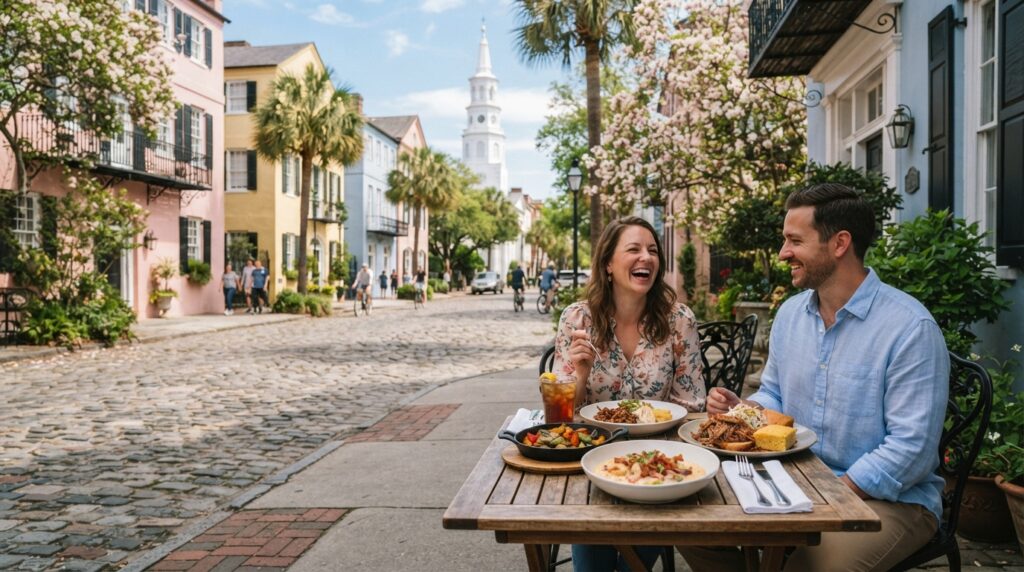
Charleston is our best pick for travelers who want Southern food and hospitality alongside a complex, visible history. Its historic district brings architecture and regional food traditions into the same visit. Miami and Santa Fe offer very different cultural influences.
Charleston’s beauty exists alongside a difficult history, including its connection to the transatlantic slave trade. Miami’s Little Havana and arts scene reflect Cuban and Latin American influences. Santa Fe, New Mexico’s capital, has distinctive architecture and regional cuisine.
Charleston and Savannah for Southern history and hospitality
Charleston and Savannah offer Southern history, local food and a strong sense of place. Charleston is a particularly clear choice when we want to pair regional dishes with historic streets. Savannah gives us another Georgia setting for a visit shaped by local character.
Charleston’s older buildings tell only part of the story. The city’s past includes slavery and its lasting effects, so an honest visit should make room for that history. Architecture can be beautiful without making the events around it simple.
Miami and Santa Fe for distinct cultural influences
Miami brings Cuban and Latin American influences into its food and arts scene. Little Havana offers a chance to explore one part of that culture through neighborhood streets and local businesses. The city’s character reaches well beyond a single district.
Santa Fe offers a different experience through its architecture and regional cuisine. Its setting in New Mexico gives the city a strong Southwestern identity. We can learn more by spending time in local spaces instead of treating the visit as a checklist.
Four ways to connect with local culture include:
- Neighborhood walks
- Local markets
- Regional dishes
- Guided history tours
A guided history tour can help us understand what a building or street leaves unsaid. Choose a locally guided history experience when a destination’s architecture tells only part of its story.
Which American Getaways Work Well as Day Trips?
From the Bay Area, Monterey and Carmel-by-the-Sea are practical coastal day-trip choices when we start early and keep the itinerary focused. Fredericksburg is a Texas Hill Country option for travelers based in Austin. Both ideas work best when the drive leaves enough time at the destination.
Check actual drive time and traffic before treating a place as a one-day outing. Monterey and Carmel-by-the-Sea suit a coast-focused visit, while Austin and San Antonio offer different Texas city bases. A short trip can still feel rushed if the return journey takes most of the day.
Monterey and Carmel-by-the-Sea give Bay Area travelers a choice of coastal stops. One main activity can keep the visit easy to manage, whether we want time by the water or a walk through town. Starting early leaves more room to enjoy the day.
Fredericksburg offers a Hill Country day out from Austin. We should count the full return drive, not just the time spent going one way. If we want several stops, an overnight stay may make more sense.
Before setting out, check these four details:
- Round-trip travel time
- Opening hours
- Parking or transit
- One main activity
For other family-friendly routes and outdoor ideas, we can compare options in this family travel guide. If the return drive would leave little time at the destination, turn the outing into an overnight stay.
Which U.S. Tourist Attractions Are Most Popular?
Grand Canyon National Park tops this popularity snapshot of listed American attractions, with an 84% rating in third-quarter 2026 data. Niagara Falls follows at 82%. The figures offer one way to compare familiar places, not a measure of trip quality.
A popularity rating is not the same as an annual visitation total. The five leading entries in this table include natural wonders and historic sites, each with a different kind of appeal.
| Attraction | Popularity rating | Attraction type | State or region |
|---|---|---|---|
| Grand Canyon National Park | 84% | National park | Arizona |
| Niagara Falls | 82% | Waterfall | New York |
| Yellowstone National Park | 78% | National park | Wyoming and nearby states |
| Statue of Liberty | 78% | Monument | New York Harbor |
| Yosemite National Park | 77% | National park | California |
Other listed attractions include the Lincoln Memorial at 75%, the Empire State Building at 73%, and Great Smoky Mountains National Park at 71%. Everglades National Park and the American Museum of Natural History also rate 71%.
Sequoia National Park and Rocky Mountain National Park each rate 70%. Redwood National and State Parks, the National Air and Space Museum, the National Museum of Natural History and Mount Rushmore National Memorial each rate 69%.
These figures show how recognizable places compare in a popularity measure, but they do not show how many people visit each site. A large visitor count and a high rating answer different questions. Use popularity as one signal, then choose by the experience and travel logistics that suit us.
Grand Canyon National Park led the listed American attractions in YouGov Ratings’ third-quarter 2026 data. Popularity can suggest a familiar starting point, while trip length, access and the kind of day we want should shape the final choice.
Which Destinations Across the Americas Belong on a Bucket List?
Machu Picchu is our clearest bucket-list choice across the Americas when ancient history and an extraordinary mountain setting are the draw. Patagonia suits hiking and dramatic scenery, while the Galápagos Islands stand out for wildlife. Each destination offers a distinct reason to travel.
Plan around the main experience, then leave room to explore beyond one famous viewpoint. Hiram Bingham is credited with exposing Machu Picchu in 1911. The Galápagos Islands are 97% national park.
| Destination | Country or countries | Signature draw | Trip style |
|---|---|---|---|
| Machu Picchu | Peru | Inca citadel and Andes setting | History and hiking |
| Patagonia | Chile and Argentina | Glaciers and mountain peaks | Hiking and nature |
| Galápagos Islands | Ecuador | Wildlife and marine life | Guided nature trip |
| Lake Atitlán | Guatemala | Volcanic lake and Mayan villages | Lakeside culture |
| Iguazú Falls | Argentina and Brazil | Extensive waterfalls | Viewpoints and boat excursions |
Machu Picchu combines an Inca citadel with an Andes setting. The site’s history and mountain views give us a reason to slow down and take in more than one angle. Its place in Peru makes it a strong choice for a history-focused adventure.
Patagonia spans Chile and Argentina, with glaciers and mountain peaks that suit hiking and nature trips. The Galápagos Islands offer guided visits centered on wildlife and marine life. Lake Atitlán pairs a volcanic lake with Mayan villages, while Iguazú Falls offers viewpoints and boat excursions.
These destinations call for care as well as curiosity. We should follow site rules, respect protected habitats and make room for the wider setting around the main attraction. Allow time to explore beyond a single viewpoint, while respecting site rules and protected habitats.
Which World-Famous Historic Sites Are Worth the Long-Haul Trip?
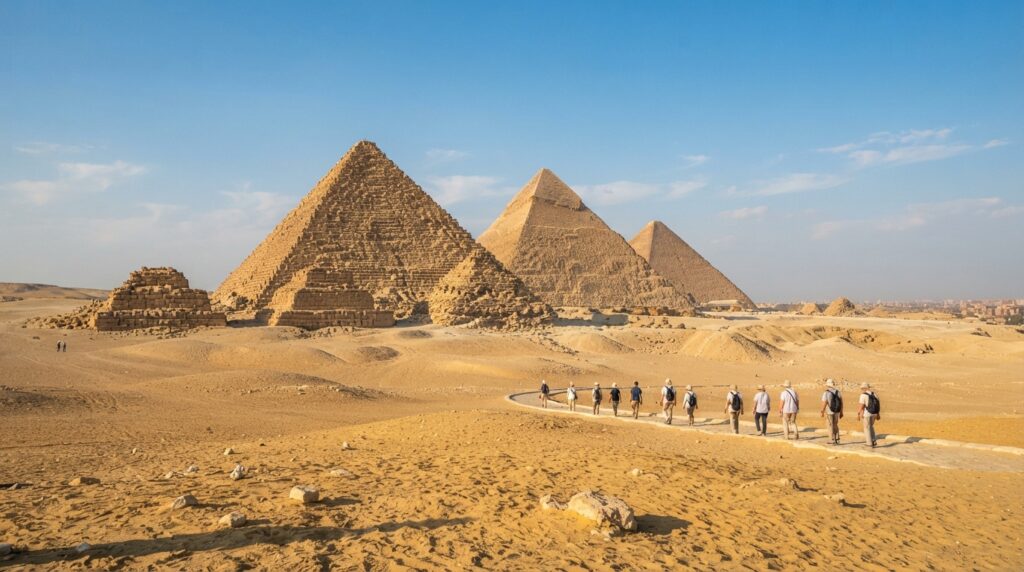
Giza is our strongest first choice for travelers who want to encounter the scale of ancient monumental construction. The pyramids are about 4,500 years old. The Taj Mahal and Angkor Wat offer different forms of architecture and cultural history.
Pair each major site with the nearby city that helps us understand its wider setting. Cairo adds a busy urban contrast to Giza, Agra gives context to the Taj Mahal, and Siem Reap is a base for Angkor Wat.
Ancient cities and archaeological landmarks
Giza gives us a close look at ancient engineering on a grand scale. The pyramids stand near Cairo, where city life offers a sharp contrast to the open site. We can use time in both places to see how the landmark fits into a larger cultural setting.
Angkor Wat belongs to a vast temple complex built between the 9th and 15th centuries. The complex covers 250 square miles, so one temple visit cannot represent the whole area. Siem Reap provides a base for exploring more than the best-known structure.
Monumental architecture and cultural heritage
The Taj Mahal offers a close study of Mughal architecture. Construction was commissioned in 1632, and Agra gives the site a wider urban context. A visit can focus on the building’s design as well as the history around it.
These sites are not interchangeable, even though all draw visitors through history and architecture. Giza centers on ancient construction, the Taj Mahal on Mughal design, and Angkor Wat on a broad temple complex. Plan for the wider site and its cultural context, not just the best-known photo stop.
Which Islands and Reefs Are Worth Planning a Trip Around?
Bora Bora is our pick for a lagoon-centered island escape, while the Great Barrier Reef suits travelers whose main goal is seeing a vast coral ecosystem. The two trips feel different: one centers on a South Pacific island stay, the other on marine exploration.
The Great Barrier Reef stretches about 1,800 miles and includes over 3,000 reef systems and coral cays. It is the world’s largest coral reef system. Bora Bora is about 160 miles from Tahiti and about 2,600 miles from Hawaii.
Bora Bora and the South Pacific
Bora Bora’s lagoon and small motu, or islets, suit swimming and island stays. We can spend time in the water or keep the day focused on the island’s setting. Its distance from Tahiti helps show why the trip calls for planning beyond a quick stop.
A lagoon visit is not the same as a reef expedition. Bora Bora works well when we want an island base and time around sheltered water. Conditions can vary, so our plans should leave room for changes.
The Great Barrier Reef and Australia’s coast
The Great Barrier Reef can be explored through coastal gateways such as Cairns. Snorkeling, diving and boat trips offer different ways to experience the water. Snorkeling suits a surface view, diving takes us below it, and a boat trip can keep us above the water.
Reef conditions and wildlife encounters vary, so no single outing promises a particular sighting. We should follow local guidance and avoid touching coral or marine animals. Choose reef activities that follow local marine-protection rules and do not touch coral or wildlife.
Which Global Natural Wonders Belong on a Bucket List?
Cappadocia is our first pick for otherworldly landforms and sunrise hot air balloons above its central Turkish valleys. Its fairy chimneys and cave dwellings make the region stand out. Uyuni, Ha Long Bay and Antarctica offer very different natural scenes.
Weather can affect balloon flights, mirror effects and Antarctic landings. We see beauty differently, so this is a subjective shortlist rather than an objective global ranking. Our seven picks are Cappadocia, Uyuni Salt Flats, Ha Long Bay, Antarctica, Patagonia, the Grand Canyon and Bora Bora.
Cappadocia and the Uyuni Salt Flats
Cappadocia’s central Turkish valleys are known for fairy chimneys and cave dwellings. A sunrise hot air balloon flight can show the unusual landforms from above, though weather may ground balloons. We should treat the flight as an option, not the whole reason to visit.
Uyuni Salt Flats can form mirror-like reflections when a thin layer of water covers the flats. The effect depends on conditions, so the white expanse itself remains part of the experience. We can plan for the landscape without expecting one exact look.
Ha Long Bay and Antarctica
Ha Long Bay has more than 1,600 limestone islands. A boat trip gives us a way to see the cliffs and water together, while a longer stay can offer more time to explore. The bay’s shape makes it a memorable nature-focused destination.
Antarctica offers a remote expedition and a very different sense of scale. Landings depend on weather, so plans can change even after a trip begins. Build flexibility into a nature-focused itinerary, because weather can change the experience.
Our subjective seven-place shortlist answers the search for beautiful places through varied settings, not a contest. Patagonia and the Grand Canyon offer dramatic landforms, while Bora Bora adds a lagoon and island view. No list can decide what beauty means for every traveler.
How Can We Turn These Picks Into a Trip That Fits?
A city break usually needs less time than a multi-stop international itinerary, so begin by setting the number of days we can actually travel. Trip length shapes the plan, from how many neighborhoods we visit to how often we change bases.
Keep each trip focused on one city, region or country rather than packing in too many stops. These general time allowances can help us set a realistic starting point.
| Trip type | General time allowance | Best fit |
|---|---|---|
| City break | Usually 2-4 days | One city and a few neighborhoods |
| Single-region trip | Usually 4-7 days | One region with limited transfers |
| Long-haul trip | Usually 7-14 days | One country or a focused multi-stop route |
A ten-place inspiration set can help us start a worldwide shortlist: Grand Canyon, Yellowstone, New York City, San Francisco, Machu Picchu, Patagonia, Galápagos Islands, Rome, Tokyo and Great Barrier Reef. It is a set of ideas, not a fixed order.
A broader country list can also help us compare regions. Consider the United States, Canada, Mexico, Peru, Chile, Ecuador, Brazil, France, Italy, Greece, Iceland, Norway, Egypt, Jordan, Turkey, Japan, Vietnam, Cambodia, Indonesia and Australia.
Before booking, check five planning points:
- Trip length
- Season
- Transport
- Access requirements
- Backup plan
U.S. citizens need a valid passport book for international air travel. Entry rules also differ by destination, so check each country’s requirements before booking.
Keep the route focused enough to enjoy each stop. U.S. citizens should check passport validity and entry rules for every country before paying.
Travel style matters as much as the number of days. A city visit may suit travelers who want to walk and use transit, while a remote region may need more time between stops. U.S. citizens should check passport validity and entry rules for each country before booking.
Conclusion
A memorable trip does not need to cover the whole list; one well-chosen destination is enough to begin. The best fit is the place that matches our available time and the experience we value most. A trip built around one clear aim often feels richer than one packed with stops.
First, choose a style: city streets, open land, local food or time by the water. Then save one destination to a shortlist and check what the season allows. Pick one destination, check its current access and seasonal conditions, and start shaping the trip around it.