A rewarding Europe trip does not have to follow the same famous-city route as everyone else. A “hidden” place can still draw visitors, especially when many people travel at once. These 15 destinations offer a different mix of historic towns, UNESCO sites, mountain scenery, and beaches.
We can use this list to find a place that suits our plans, whether we want an easy city break or time outdoors. The shoulder season is the period between peak season and off-season, commonly spring and fall in Europe. A thoughtful pick can add a fresh side to a trip without making every stop feel remote.
“Underrated” does not mean unknown, and quieter destinations still have busy days. We can make the most of them by choosing a pace that leaves room to look around, rather than rushing through a long list of stops. Treat this list as a starting point, then choose places that fit the season and pace of your trip.
Key Takeaways
- Choose a destination for its history, scenery, coast, or city life.
- Plan an overnight stay when a town’s streets deserve more than a day visit.
- Check seasonal openings before booking a small-town winter stay.
- Use trains and buses for major links, then plan the final connection.
- Allow two to three nights at each base for a more relaxed trip.
- Check current entry rules before leaving the United States.
Which Hidden Gems in Europe Reward an Overnight Stay?
For an overnight historic-town stay, Sighişoara is the strongest medieval choice, while Zamość and Ljubljana offer very different kinds of architecture and street life. Each rewards time on foot, but Sighişoara has the clearest citadel setting.
Choose Sighişoara for medieval atmosphere, Zamość for Renaissance design, and Ljubljana for a compact car-free center. These destinations europe picks suit travelers who want a town or small city with a strong sense of place.
Sighişoara, Romania
Sighişoara developed in the 12th century, about 300 kilometers north of Bucharest. Its UNESCO-listed citadel still feels like part of a living town, not a museum set. We can walk its fortified walls and see the 14th-century clock tower among homes and everyday streets.
The 14th-century clock tower helps anchor a visit, but an overnight stay gives us more than a landmark stop. In the evening, the lanes and squares feel different once day visitors leave. Among hidden gems in Eastern Europe, it is a fitting choice for a medieval-citadel stay.
In Sighişoara, staying overnight gives us time to see the citadel after day visitors leave.
Zamość, Poland
Zamość is a UNESCO-listed Renaissance town founded in the 16th century. An Italian architect designed its urban plan, giving the historic center a clear, ordered shape. We can spend time noticing how the streets and main square work together, rather than treating the town as one scenic photo stop.
For travelers looking for beautiful small towns in Europe, Zamość offers a different appeal from a medieval citadel. Its planned streets and Renaissance architecture make it a strong fit for people who enjoy the design of a town as much as its landmarks.
Ljubljana, Slovenia
Ljubljana’s historic center is car-free, with the Ljubljanica River running past riverside markets and Ljubljana Castle. That mix makes it a comfortable place for an overnight city stay. We can follow the river through the center, stop near the markets, and cross back through the pedestrian streets.
Ljubljana is the best fit of these three for a compact, car-free center, while Zamość suits architecture-focused travelers. Sighişoara remains the clearest medieval choice. Other brief alternatives for historic architecture and distinct local styles include:
- Mostar and Sarajevo for historic architecture.
- Gjirokastër for Ottoman-era stone architecture.
- Matera for its sassi, or historic cave dwellings.
These destinations offer different kinds of atmosphere, so we can match the stay to what we most want to see. An extra night also leaves room for a slow meal or an evening walk, instead of squeezing the visit into a short stop.
Where Can We Find Characterful City Breaks Beyond the Capitals?
Girona makes an easy extension to a Barcelona trip, with its medieval walls doubling as a walkable viewpoint. Bruges brings a different city feel, while Edinburgh pairs a capital setting with notable heritage.
Bruges is the most straightforward of these three to reach from Brussels Airport for a shorter city break. Girona suits a Barcelona add-on, and Edinburgh works for travelers who want a larger city with distinct historic districts.
Girona, Spain
Girona lies 40 minutes north of Barcelona by train, making it a practical change of pace during a trip to Catalonia. Its medieval walls offer a walkable viewpoint over the city. We can follow the wall path, then continue into streets that reward a slower look.
The city gives us history and a more compact feel without asking us to leave the region. It can suit a day visit, though an overnight stay gives us more time for the old center and its food spots.
Bruges, Belgium
Bruges has a historic center that is easy to explore on foot, and it is reachable from Brussels Airport by train in just over one hour. That rail link makes it a useful choice when we want a European destination with an easy airport connection.
We can spend a short break moving between the old streets, canals, and central squares. The city is well known, so we should not treat it as undiscovered; its strength is a clear, walkable historic setting.
Edinburgh, Scotland
Edinburgh’s Old and New Towns form a UNESCO World Heritage site. The city has been Scotland’s capital since the 15th century, and its historic core sits alongside a later planned district.
Edinburgh is a familiar city, not a hidden one. We include it for its linked heritage and the contrast between its Old and New Towns, which gives a short city break more than one kind of street scene.
Each city suits a different plan: Girona is an easy addition to Barcelona, Bruges makes a practical rail-linked break, and Edinburgh offers a capital-city stay with deep history. We can choose based on how much time we have and whether we want a compact visit or a larger urban base.
For a shorter city break, Bruges is the most straightforward of these three to reach from Brussels Airport.
Which Historic Sites Bring Europe’s Past Into Focus?
Meteora is the most visually singular choice here, while Brú na Bóinne and Stonehenge and Avebury offer different ways to explore prehistoric heritage. The landscape shapes each visit, from a river bend to a wide field of monuments.
Choose Meteora for the most striking setting, or Brú na Bóinne for a focused visit to major prehistoric sites. These places suit travelers who want history beyond a city itinerary.
Brú na Bóinne, Ireland
Brú na Bóinne brings together Newgrange, Knowth, and Dowth along a bend in the River Boyne. The UNESCO World Heritage site gives us a concentrated way to explore prehistoric heritage in a distinct riverside setting.
We can use the site’s three main places to shape a focused visit, rather than trying to cover a wide region in one day. Its appeal comes from the close link between ancient structures and the surrounding land.
Stonehenge and Avebury, England
Stonehenge and Avebury are UNESCO-listed sites in Wiltshire, but the wider area offers more than one famous stone circle. Associated monuments include Woodhenge and West Kennet Long Barrow.
That broader setting gives us a fuller sense of how many historic features sit within the region. We can plan time for the nearby monuments as well as the best-known site, making the visit about more than one stop.
Meteora, Greece
At Meteora, six monasteries remain open to visitors on top of tall rock pillars. The scene is visually unlike a typical city or archaeological visit, and nearby Kalabaka and Kastraki offer places to stay.
Meteora is the most unusual pick here for travelers seeking dramatic views and a strong sense of place. Matera’s cave dwellings and Castelmezzano’s dramatic vertical setting are two more ideas for an unusual trip, though neither is a featured stop here.
These sites each bring history into focus in a different way: a group of prehistoric places, a broad monument area, or monasteries above the plain. For an unusual visit, Meteora stands out; for a concentrated prehistoric visit, Brú na Bóinne is the clearest fit.
At Meteora, staying in Kalabaka or Kastraki makes it easier to visit outside the busiest day-trip hours.
Where Can We Trade Crowded Hotspots for Scenic Escapes?
Choose Lake Bohinj for a nature-focused lake stay, Lavaux for vineyard walks, or the Mani Peninsula for a mix of coast and mountain scenery. Each offers a different outdoor pace, from lakeside activity to village-to-village exploring.
Bohinj is the best fit for a lake-centered nature stay, Lavaux for vineyard scenery, and Mani for mixed coast and mountain exploration. These underrated destinations in Europe suit travelers who want views beyond a busy city center.
Lavaux Vineyard Terraces, Switzerland
The Lavaux Vineyard Terraces stretch about 30 kilometers along Lake Geneva, from Château de Chillon to Lausanne’s eastern outskirts. The UNESCO World Heritage site includes Chexbres, Rivaz, and Saint-Saphorin, linking vine-covered hills with walkable villages.
Present vine terraces can be traced to the 11th century. We can make this a slow scenic stay by walking between villages and pausing for the views, rather than trying to cover the whole region in a rush.
Lake Bohinj, Slovenia
Lake Bohinj sits within Triglav National Park and suits a low-key nature stay. We can spend time on the water or use the lake as a base for nearby trails, with fewer motorized activities shaping the visit.
Motorized water vehicles are prohibited on the lake. That rule makes the choice of activity simple: use a kayak, canoe, stand-up paddleboard, or electric ferry instead of a motorized craft.
Mani Peninsula, Greece
The Mani Peninsula forms part of the Peloponnese and offers coastal villages beside a rugged mountain interior. We can pair time near the water with walks or drives inland, making it a good choice when one landscape is not enough.
Mani suits a trip built around a mix of coast, villages, and mountain scenery. It is less focused on one activity than Bohinj or Lavaux, so we can shape days around the area that appeals most.
For a lake-centered nature stay, Bohinj is the strongest match. Lavaux is the clear pick for vineyard scenery, while Mani offers a varied coastal and inland route.
At Bohinj, choose a kayak, canoe, stand-up paddleboard, or electric ferry rather than a motorized watercraft.
Where Are Europe’s Quieter Coastal Escapes?
For shallow water and small offshore islands, Ksamil is the clearest match; Balos and Vis suit different kinds of nature and swimming trips. Each gives us a distinct coast, from a protected lagoon to swims from rocky shores.
Choose Ksamil for shallow water and offshore islets, Balos for protected nature, and Vis for swimming from rocks. These beach destinations can fit a trip focused on clear water, quiet coves, or a mix of shore and island life.
Ksamil, Albania
Ksamil has shallow turquoise water and three small rocky islands just offshore. The village is a 30-minute ferry ride from Corfu, making it a useful option for a beach-focused trip near the Greek island.
Its shallow water and nearby islets make Ksamil the most direct fit for an easy swim-and-shore day. We can spend time near the village or look out toward the islands without turning the visit into a long inland excursion.
Balos Lagoon, Crete
Balos Lagoon is a protected habitat for monk seals and loggerhead sea turtles. Visitors reach the beach by boat or by driving and hiking down, so the approach is part of the day’s plan.
Balos is the strongest choice here for a nature-focused coast visit. We can choose the boat route or the drive-and-hike approach based on the kind of day we want, while keeping the protected habitat in mind.
Vis Island, Croatia
Vis offers swimming off the rocks at Rukavac, which suits travelers who enjoy a less classic beach setup. It can be a good island stay when we want to swim from shore without relying on a broad sandy beach.
For other coast stops, Zlatni rat on Brač is scenic, but tourists and boat tours can make it busy. Incebogaz Cinar Beach near Kaş is about a one-kilometer walk from town, and early arrival helps us find space on the sand.
Burgau is a beach town in Portugal’s Algarve, a short drive from Lagos, with cool water. Ölüdeniz’s Blue Lagoon can be crowded in summer high season. La Graciosa is another island option, with sandy paths and volcanic trails.
At Balos Lagoon, choose between the boat approach and the drive-and-hike route before setting out.
When Should We Visit Europe’s Quieter Destinations?
For broad choice of open attractions, May through September is the most reliable European travel window, while April and October can work better for quieter routes outside the Mediterranean. Season changes what is open, not just how many people we meet.
Peak season runs roughly May through September, shoulder season is April and October, and off-season is November through March. These ranges give us a starting point, but local patterns can shift the best time to visit.
| Period | Typical months | What to expect | Best-fit trip style |
|---|---|---|---|
| Peak season | May-September | Broadest choice of open attractions | First visits and full sightseeing days |
| Shoulder season | April and October | Quieter in many areas, but patterns vary | Flexible city and countryside trips |
| Off-season | November-March | Rural stays and tours may close | Large-city sightseeing and winter stays |
Scandinavia is a clear exception to broad spring and fall advice. Its tourist season runs roughly from mid-June through late August, and many sights there are sleepy or closed during shoulder season.
In much of Mediterranean Europe, April and October can bring near-peak crowds and prices, even though those months fall within shoulder season. A month alone does not promise a quiet or low-cost visit. We should match the season to the region and the kind of trip we want.
Many smaller or rural accommodations close from November through March. Some tourist-oriented parks, shows, and tours also close, while short daylight limits time outdoors. A large city is usually an easier winter sightseeing choice than a small tourist town, where restaurants and sights may shut for the season.
Check the typical European travel seasons against the region we want to visit, especially outside the main months. Before booking a winter stay in a small town, confirm that the sights and restaurants we plan to use will be open.
How Can We Reach These Places Without Overplanning?
Trains and buses are usually the simplest starting point for city-to-city travel, while a car or ferry can make remote coastlines and rural stops easier to reach. Start with the main link, then plan how we will reach the final stay.
Use public transport for major towns and consider a car or boat for remote beaches and trailheads. A route can look simple on a map but still need a local transfer at the end.
| Option | Best use | Main trade-off | Example of when it fits |
|---|---|---|---|
| Regional train | Town and city links | May not reach remote stops | Travel between connected city centers |
| Intercity bus | Major towns on a budget | Road travel can take longer | Connecting towns without a direct train |
| Rental car | Rural stops and trailheads | Driving and parking add work | Exploring villages beyond a rail line |
| Ferry | Island and coastal links | Departure times shape the day | Reaching an island or crossing a bay |
Regional trains and intercity buses can connect major towns without requiring a complex route. Remote beaches and rural trailheads may need a car, boat connection, or local transfer after the main journey.
FlixBus fares can start at €5 one way. FlixBus tickets can be changed or canceled up to 15 minutes before departure for €1. The low fare may suit a simple intercity leg, while a rural stay can need a separate connection.
A rental car can help when our stops sit far from rail or bus routes, but it can add planning around driving and parking. Ferries make island access possible, though our day depends on departure times. We can keep the route straightforward by avoiding too many modes in one trip.
Check the full route, including the final connection to the stay, before booking a cheap intercity ticket.
How Can We Keep an Offbeat Europe Trip Affordable?
A place can feel affordable only after we compare the full trip, not just its meals or hotel rate. Four cost areas matter: lodging, intercity transport, meals, and activities.
A useful trip budget tracks all four categories before we decide what fits. A country-level price comparison can offer context, but it is not a personal trip quote.
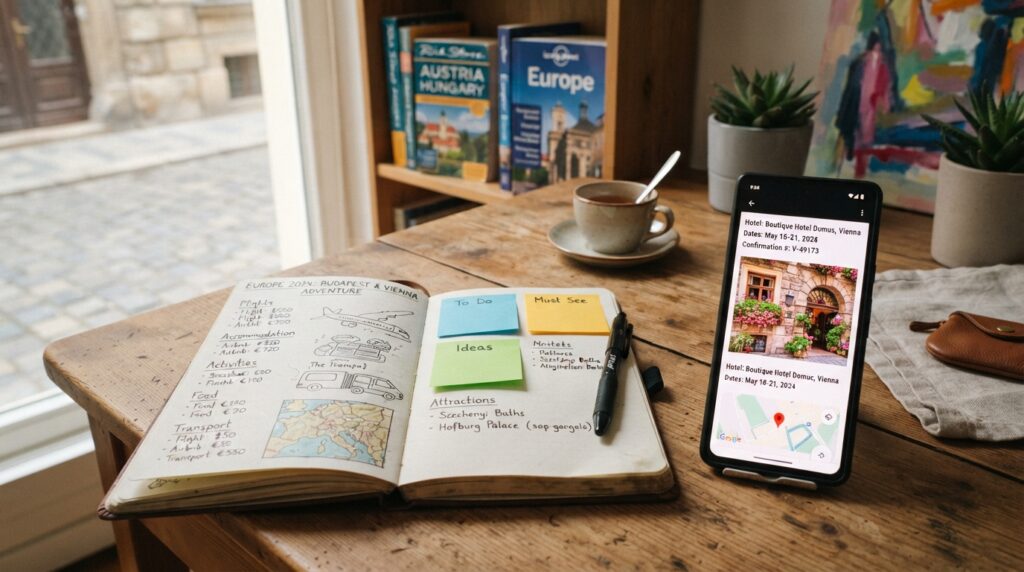
We can use a full-trip budget approach to compare the costs that shape our plans. Eurostat publishes household consumption price-level comparisons between countries, but airfare and exchange rates can change what we pay.
- Compare lodging dates and the cost of each place to stay.
- Estimate local transport for the route we plan to use.
- Set a meal allowance that suits our daily habits.
- Check paid activities and decide which ones matter most.
Flight prices and exchange rates can shift the total, even when local prices look modest. Keep one flexible line in the budget for costs that change with the route or travel dates.
What Should U.S. Visitors Check Before Departure?
U.S. visitors should check the current EES and ETIAS requirements before leaving, since the two systems serve different purposes. Both affect border planning, but only one was already rolling out in the period described.
The Entry/Exit System (EES) began rolling out across 29 countries in October 2025. ETIAS, the European Union’s pre-travel authorization for visa-exempt visitors, was slated to begin in late 2026.
- Check current entry rules for every destination on our route.
- Allow for EES fingerprint and facial-scan registration when entering for a short stay.
- Verify ETIAS status close to departure because its announced start was slated for late 2026.
EES and ETIAS are separate systems. EES requires U.S. visitors entering for short stays to provide fingerprints and facial scans, while ETIAS is a pre-travel authorization for visa-exempt visitors.
Entry rules can change, and our route may cross more than one border system. Confirm current requirements with official authorities, then recheck official requirements close to departure rather than relying on an old booking confirmation.
How Can We Make These Places Feel Less Rushed?
A slower trip usually works better when we choose one base and explore nearby rather than changing hotels every night. One good base can give us room for a long meal, a local walk, or a change in the weather.
Two to three nights per base is a practical rule of thumb for an unhurried visit. Keeping day trips to roughly one to two hours each way can leave more time at the destination.
| Trip style | Good starting pace | What to cluster nearby | Main planning check |
|---|---|---|---|
| City break | 2-3 nights | Walkable neighborhoods and museums | Opening hours and local transit |
| Coast stay | 2-3 nights | Nearby beaches and harbor towns | Ferry times or local transfers |
| Rural or mountain stay | 2-3 nights | Nearby trails and villages | Trail access and weather |
We can use a few simple steps to keep the route manageable:
- Pick one anchor place that we really want to visit.
- Add only nearby stops that fit the same base.
- Reserve time for weather or one small discovery.
If the route needs several long transfers, remove a stop before adding another travel day.
Personal travel often feels best when it leaves space for the things we love, not just the sights we planned. We may find a nice café, a quiet path, or a local event that changes the day. That room to adapt can be part of what makes a place stay memorable.
Conclusion
The strongest choice is the place that fits the way we want to spend our days, not simply the one with the most striking photos. Some travelers want culture and walkable streets; others want nature, coast, or a slower pace.
We do not need to build a trip around every appealing stop. One thoughtful base can give us time to see the place well and enjoy nearby things without turning each day into a transfer.
Choose one featured place, check its season and access, then build nearby stops around it. That first choice gives us a clear way to shape the rest of the route. Pick one place that genuinely appeals to us and start by checking its season and route.