Washington, D.C., is our strongest all-around first history trip, while St. Augustine, Boston, and Philadelphia are compelling alternatives for distinct eras. The country has 27 UNESCO World Heritage Sites, spanning cultural, natural, and mixed properties.
These destinations cover different periods and regions, from Spanish colonial settlements to national government and the American Revolution. We can choose a trip that fits our interests, whether we want museums, historic streets, or a closer look at communities often left out of familiar stories. The places below offer a starting point for planning a visit around the past that matters most to us.
Key Takeaways
- Washington, D.C., offers a broad first look at national history.
- Boston and Philadelphia focus on the Revolutionary era.
- St. Augustine highlights Spanish colonial and Black history.
- San Antonio connects Spanish missions with Texas history.
- Historic sites can differ greatly in size, access, and setting.
- Choose a city by the period and communities you most want to understand, not just by its most famous monument.
Which Historical Cities to Visit Across the United States?
Washington, D.C., is the most flexible choice for a first trip, while Boston, Philadelphia, St. Augustine, and San Antonio suit visitors focused on particular eras. Start with your interests, then compare landmarks, routes, and the time each place deserves.
The United States has 27 UNESCO World Heritage Sites: 13 cultural, 13 natural, and one mixed. Mesa Verde National Park and Yellowstone National Park joined the World Heritage List in 1978, while Okefenokee National Wildlife Refuge became the newest U.S. site in 2026. UNESCO recognition applies to listed properties, not to a citywide ranking.
| City | Key historical era | Signature landmark | Best-fit interest |
|---|---|---|---|
| Washington, D.C. | National government and memorials | National Mall | Broad survey |
| Boston | Colonial and Revolutionary history | Freedom Trail | Walking route |
| Philadelphia | Founding-era history | Independence Hall | Declaration and Constitution |
| St. Augustine | Spanish colonial history | Castillo de San Marcos | Early European settlement |
| San Antonio | Spanish colonial and Texas history | San Antonio Missions | Mission architecture |
These choices also work as pairings when two nearby places fit one trip. The links below are practical combinations, not claims that each stop shares one history.
- Washington, D.C., with the National Mall
- Williamsburg with Jamestown
- Boston with Salem
Use UNESCO status to identify a listed property, not to rank every city or historic site in the country.
A city can have important local history without a UNESCO listing. The places in our comparison also differ in how much ground they cover, so their signature landmarks can help us choose. Use a city’s signature period to choose a destination, then check how its historic sites fit together geographically.
What Can We See in Washington, D.C.?
We can trace national history in Washington, D.C., from the monuments on the Mall to the documents and museums nearby. The outdoor memorials make a clear starting point, while nearby institutions add context through records, art, and presidential history.
Plan at least one museum or archive alongside time outdoors. Admission and access rules differ by institution, so visitors should check current details before building a day around one stop.
The National Mall and its memorials
The Washington Monument, Lincoln Memorial, and other memorials offer a walkable introduction to national history. We can follow the paths between them and see how each landmark recalls a person, conflict, or public ideal.
The broad Mall setting helps visitors connect monuments that might seem separate on a map. A walk beside the Reflecting Pool gives us space to pause between stops, rather than treating each memorial as a quick photograph.
Museums, archives, and the White House
The Smithsonian museums cover subjects from art to science, while the National Archives holds key records. The Library of Congress houses millions of books, and its rooms show how a national library serves the public.
The White House was completed in 1800. Visitors can learn about the president’s home at the White House Visitor Center, while Ford’s Theatre and the Petersen House add a distinct chapter in presidential history.
For a focused day, we can link nearby stops by theme rather than trying to see every collection. National Mall destination ideas can help us compare the capital with other U.S. trips.
- Memorials with the Reflecting Pool
- Library of Congress with the National Archives
- Ford’s Theatre with the Petersen House
- Smithsonian museums with the National Mall
Set aside time for one museum or archive alongside the outdoor memorials rather than treating the Mall as the whole visit.
How Does Boston Tell the Story of the Revolution?
Boston lets us follow a 2.5-mile route past 16 sites tied to the city’s colonial and Revolutionary past. The Freedom Trail turns the city into a walking history tour, with landmarks spaced along streets and public squares.
The 2.5-mile trail connects 16 significant historical sites. It does not mean every stop offers an interior visit, and some sites are best understood from outside.
Walk the Freedom Trail
The route links places such as the Old State House, Paul Revere House, and Old North Church. The Paul Revere House was built around 1680, while Old North Church dates to 1723.
Those buildings show different parts of the city’s past, from home life to public debate and religious practice. A marked path makes it easier to connect these events, though visitors should allow for street crossings and separate site entrances.
The American Revolution was not the only story shaped by Boston’s streets. The city’s Black community, abolitionist work, religious life, and maritime trade deserve attention beside the familiar events.
Look beyond the Revolutionary landmarks
We can add stops that bring other communities and themes into view. The African Meeting House, USS Constitution, and Old South Meeting House each offer a different way to explore Boston’s history.
- African Meeting House
- USS Constitution
- Old South Meeting House
Historic site access can vary, so a walking route may include outdoor views as well as visits inside. The Freedom Trail is also one part of a wider trip, not a substitute for exploring the city’s other neighborhoods.
Boston’s route is a strong choice when we want to walk between landmarks rather than drive from one site to another. The range of U.S. travel destinations also includes places with very different ways to tell history.
Choose a few interiors that match your interests instead of assuming every Freedom Trail stop offers the same kind of visit.
What Makes Philadelphia a Founding-Era Destination?
Philadelphia is the clearest U.S. destination for seeing the places associated with the Declaration of Independence. Independence Hall anchors the story in the building where the document was signed.
Independence Hall was completed in 1753 and hosted the signing of the Declaration of Independence in 1776. The hall and the Liberty Bell are separate landmarks with related, but different, meanings.
Independence Hall and the Declaration
Visitors can see the building where delegates debated the country’s founding documents. Its rooms connect political ideas with the people who shaped them, including those whose lives and rights were not reflected in those documents.
Philadelphia’s history is not contained in one building. The Museum of the American Revolution suggests regional routes to places such as Valley Forge, Germantown, Brandywine Valley, and Washington Crossing.
The museum’s Revolutionary history itineraries offer ideas for extending a Philadelphia visit. These routes can help us decide whether to focus on the city or add sites beyond it.
The Liberty Bell and Philadelphia’s historic streets
The Liberty Bell is a separate stop from Independence Hall. Its symbolic role has grown over time, while the hall’s importance comes from the founding-era debates and signing held there.
Elfreth’s Alley was formed in 1702, and its current homes were built between 1728 and 1836. The street gives visitors a look at the age and scale of an early urban neighborhood.
- Elfreth’s Alley
- Carpenter’s Hall
- Benjamin Franklin Museum
- Betsy Ross House
These places offer different ways to meet the people, work, and ideas tied to the city’s past. We can choose a few that fit our interests, rather than treating every historic site as part of one visit.
Keep Independence Hall and the Liberty Bell as two distinct stops when mapping a visit.
What Can We Explore in St. Augustine and Beyond?
St. Augustine is the strongest choice for early Spanish colonial history in the continental United States. Its story also includes Black history, coastal defense, and later landmarks shaped by Florida’s growth.
St. Augustine was founded in September 1565 by Spanish admiral Pedro Menéndez de Avilés. Coquina is a porous limestone made mostly of shell fragments cemented together.
Fort Matanzas visitors need a free ferry boarding pass, issued first-come, first-served at the downtown Visitor Center.
Spanish defenses and the colonial city
The Castillo, the historic name we use for the Castillo de San Marcos, was built from coquina between 1672 and 1695. The site covers more than 20 acres along the downtown corridor, and the Castillo is described as Florida’s oldest building.
Fort Matanzas guarded the city’s southern approach when it was completed in 1742. The small fort measures 50 feet on each side and has a 30-foot tower.
St. Augustine’s Old City Gate was built in 1808 as a defense. Aviles Street is described as the oldest street in the United States, placing everyday movement beside the city’s military past.
Fort Matanzas requires a separate ferry trip. Its free boarding passes are available at the downtown Visitor Center on a first-come, first-served basis.
Fort Mose and Black history
In 1738, Spain’s governor of Florida offered freedom to people escaping slavery from the British colonies if they converted to Catholicism. Fort Mose became the first legally sanctioned community of free Black people in what would become the United States.
Fort Mose also served as St. Augustine’s northern defense. It saw action in the Battle of Bloody Mose in 1740, showing that Black history and military history meet at this site.
The lighthouse, Flagler-era buildings, and Florida detours
The St. Augustine Lighthouse dates to 1874, rises 165 feet, and has 219 steps to its observation deck. The Lightner Museum occupies the former Alcazar Hotel, built in 1888 by Henry Flagler.
The city also has 42 miles of Atlantic beaches, but other Florida history sites are separate trips. Fort Jefferson in Dry Tortugas National Park was built from 1846 to 1876 with 16 million imported bricks.
| Site | Location | Date or period | Defining detail |
|---|---|---|---|
| Castillo de San Marcos | St. Augustine | 1672-1695 | Coquina fort |
| Fort Jefferson | Dry Tortugas National Park | 1846-1876 | 16 million imported bricks |
| Gilbert’s Bar House of Refuge | Stuart | Florida refuge system, 1876-1886 | Last of 10 original houses of refuge |
Gilbert’s Bar House of Refuge in Stuart and Fort Jefferson are separate Florida destinations, not nearby St. Augustine stops. St. Augustine also offers enough history and beach access for a visit centered on the city.
Pick up Fort Matanzas boarding passes at the downtown Visitor Center early, since distribution is first-come, first-served.
What Does a Visit to Williamsburg Show Us?
Williamsburg turns colonial history into a lived setting, with costumed interpreters and preserved streets. Colonial Williamsburg helps us picture daily life in colonial Virginia through people, buildings, and public spaces.
The historic area offers more than 20 guided and self-guided daily tours. The experience combines interpretation and restored or reconstructed spaces, so not every structure is an original colonial building.
Visitors can see trades, homes, and civic life presented in context. Costumed interpreters bring human voices to the visit, while the streets and buildings show how a town’s design shaped daily routines.
This differs from an archaeological site, where visitors encounter remains and ongoing study rather than a staged view of past life. We can use both kinds of places to ask what is known, what has been rebuilt, and whose stories receive space.
Yorktown Battlefield adds a nearby Revolutionary-era site. It was the scene of the last major battle of the Revolutionary War, giving visitors a battlefield setting beyond the town’s interpreted streets.
Williamsburg works best when we choose tours that match our interests, such as home life, trades, or government. Some visits may focus on a guided route, while others allow more room to explore on our own.
Check which tours are running on your chosen day before deciding how much of the historic area to cover.
Why Pair Jamestown With the Virginia Historic Triangle?
Jamestown was established in 1607 as America’s first permanent English settlement. Its history includes the English colony, the Powhatan peoples, and the different ways present-day sites interpret the past.
Historic Jamestowne is the original archaeological site; Jamestown Settlement is a separate living-history museum. The distinction matters because visitors encounter active archaeology at one place and interpretive exhibits at the other.
| Stop | What visitors encounter | Historical focus |
|---|---|---|
| Historic Jamestowne | Original colony site and active archaeology | 1607 settlement |
| Jamestown Settlement | Living-history museum and replica ships | Life in 17th-century Virginia |
| Yorktown Battlefield | Battlefield landscape | Last major battle of the Revolutionary War |
At Jamestown Settlement, visitors can see replicas of the three ships that first brought colonists to Virginia. The museum offers a way to picture the journey and setting, while Historic Jamestowne centers the original site and its ongoing study.
The Indigenous Powhatan peoples are part of the region’s history, not a side note to the English settlement story. Their presence and experience help us understand that colonization took place in an inhabited homeland.
Yorktown Battlefield brings a later period into the same regional trip. The three stops do not tell one continuous story, but they show how Virginia’s history changed across generations.
Allow time to understand both the archaeology and the living-history interpretation, since they tell the story in different ways.
What Can We Learn at Gettysburg?
Gettysburg’s 6,000-acre battlefield preserves the landscape of the 1863 battle between Union and Confederate forces. The site is vast, so visitors should think of it as a landscape rather than a single monument.
Gettysburg Battlefield is a 6,000-acre military park. The Gettysburg Museum of History displays more than 4,000 historical artifacts, while the Eisenhower National Historic Site offers a distinct visit.
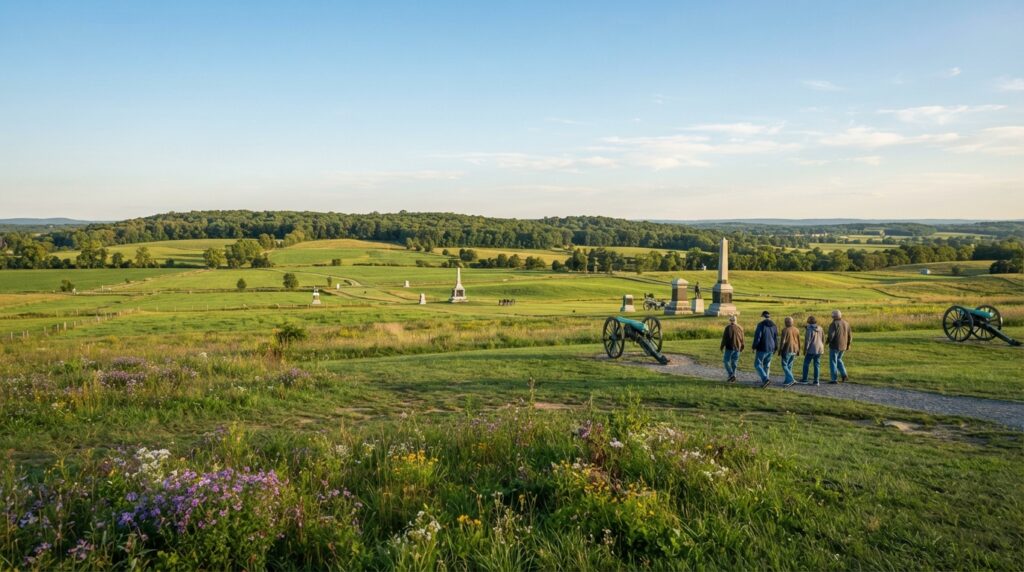
We can explore the battlefield by car, on foot, or through a guided tour. Each option changes how closely we engage with the terrain and the events that took place there.
The town’s attractions and the battlefield are not one single site. Keeping that difference in mind helps us plan a visit around the museum, historic ground, and other local stops.
The museum’s collections can add objects and context to the views outside. A National Military Park Museum and Visitor Center visit can also connect visitors with battlefield tours and ranger programs.
We can choose a self-guided route for more control or join a guide for added context. The Eisenhower National Historic Site is another stop, with a separate focus from the battle itself.
Decide whether you want a self-guided battlefield route or a guide before setting aside time for the museum.
Which Charleston Landmarks Explain the City’s Past?
Charleston’s historic harbor makes Fort Sumter and the Battery essential context for understanding the city. Start at the water, where the city’s geography helps explain the role of its harbor in the Civil War.
A history-focused visit must address slavery and the people whose forced labor shaped Charleston. Its grand homes and gardens cannot tell the full story without them.
Fort Sumter sits in Charleston Harbor, while the Battery provides a city-side view of the waterfront. Together, they help us consider how the harbor shaped Charleston’s defense, trade, and place in the Civil War.
The city’s historic houses offer different views of wealth, design, and daily life. A house museum can show how rooms were used, but visitors should also ask who built and maintained those homes.
- Middleton Place
- Aiken-Rhett House Museum
- Nathaniel Russell House Museum
These historic site choices differ in setting and focus, so one visit need not stand in for every house. Gardens and architecture can draw us in, while the history of enslaved people reveals the labor behind Charleston’s wealth.
We can make room for both the city’s built beauty and the lives that shaped it. A careful visit treats the past as more than a set of striking buildings or a harbor view.
Include the lives of enslaved people in any account of Charleston’s wealth and historic homes.
What Historic Stories Can We Find in New Orleans?
New Orleans combines an 18th-century cathedral with civic landmarks and neighborhoods shaped by changing powers. The French Quarter offers a starting point, but the city’s history reaches well beyond its oldest streets.
St. Louis Cathedral is the country’s oldest continuously active Roman Catholic cathedral. The 18th-century church stands near the Cabildo, which adds a civic view of the city’s past.
The Cabildo helps visitors explore public life and changing rule in New Orleans. A walk through the French Quarter can show how Spanish, French, and American periods left marks on the city.
Other stops offer contrasts in setting and subject. The Garden District, Chalmette Battlefield, and National WWII Museum each add a different part of the story.
- Garden District
- Chalmette Battlefield
- National WWII Museum
Cemetery tours can add local lore, though visitors should separate ghost stories from documented history. We can enjoy a tour while still asking which claims rest on records and which belong to legend.
New Orleans has many ways to spend a day, from religious history to military sites. Trip costs also depend on where we stay, how we travel, and which activities we choose; this guide to travel budgets covers those planning choices.
Choose at least one stop beyond the French Quarter to see a different layer of the city’s past.
How Do Liberty Island and Ellis Island Shape New York City’s History?
New York Harbor’s landmarks tell different stories, from the Statue of Liberty’s symbolism to Ellis Island’s immigration history. Together, the islands connect a national symbol with the journeys of people arriving in the United States.
Liberty Island and Ellis Island are separate stops with distinct histories. Visitors may combine them in one harbor visit, but each deserves time of its own.
| Stop | Location | Historical theme | Anchor detail |
|---|---|---|---|
| Statue of Liberty | Liberty Island | National symbol and immigration-era welcome | Reassembled in 1886 |
| Ellis Island | New York Harbor | Immigration inspection and arrival | Station operated 1892-1924 and received more than 12 million immigrants |
| National September 11 Memorial | Lower Manhattan | Remembrance of the September 11 attacks | Memorial site |
The Statue of Liberty was reassembled in 1886. Its image has become a lasting symbol, though Ellis Island tells a more direct story of inspection and arrival.
Ellis Island Immigration Station operated from 1892 to 1924 and received more than 12 million immigrants. Its exhibits can help us see the systems and personal journeys behind that figure.
Lower Manhattan offers another kind of memory at the National September 11 Memorial. The site gives visitors space to remember the attacks and those who died.
Harbor ferries link places that carry different meanings, so we should not treat them as interchangeable. Ellis Island gives the immigration story its own setting and detail.
Treat Ellis Island as a full historical stop, not just an add-on to the Statue of Liberty.
What Makes Savannah’s History Worth Exploring?
Savannah pairs a historic urban core with Wormsloe’s coastal landscape and colonial-era remains. The two settings offer different ways to explore the city’s past, from public streets to a site outside town.
Wormsloe Historic Site lies about 15 miles outside Savannah and has seven miles of trails. It is a separate outing, not another stop inside the historic district.
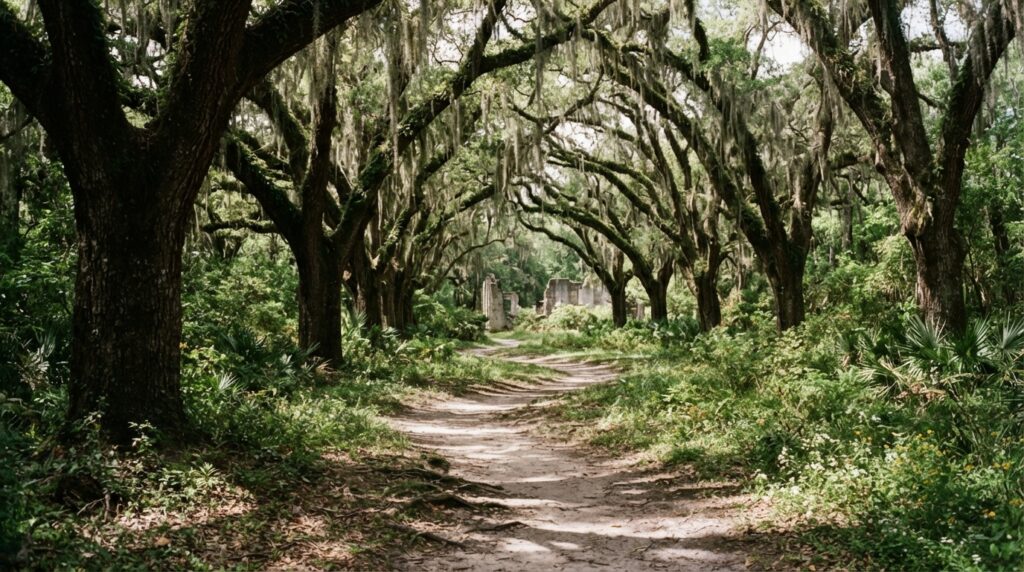
Savannah’s historic district invites us to walk among squares, homes, and public spaces. The layout can help visitors see how the city’s built form shapes a visit on foot.
Wormsloe is associated with Noble Jones and preserves a tabby ruin described as Savannah’s oldest structure. Tabby is a building material made from lime, sand, water, and shells.
The trails pass through maritime forest and marsh, creating a very different experience from the city’s streets. We can take in the coastal setting while remembering that the site also has a plantation history.
That history should be explained directly, not reduced to scenery or costumed demonstrations. The land’s beauty does not erase the people and labor connected to plantation life.
Plan Wormsloe as a separate outing from the city’s historic district.
What Should We Know Before Visiting Salem?
Salem’s history reaches beyond the 1692 witch trials to include colonial and maritime life. The trials are one chapter, not a summary of the whole city.
Salem was founded in 1626 and has more history than its witch-trial sites alone can show. Visitors can compare museums, a historic house, and a maritime site.
The Salem Witch Museum presents the trials as a focused subject, while The Witch House connects visitors with a historic home. Salem Maritime National Historic Site adds the city’s maritime past.
The 1692 events were a particular episode in a town shaped by many lives and years. Modern lore may make the story dramatic, so we should separate documented events from later claims.
A history museum can offer one kind of context, while streets and historic buildings provide another. The Salem Maritime National Historic Site helps visitors look beyond the familiar stories attached to the trials.
We can give the witch-trial sites time without letting them define every part of Salem’s past. The town’s colonial and maritime history adds context to the people who lived and worked there.
Leave room for Salem Maritime National Historic Site if you want a fuller account than the witch-trial attractions alone.
Why Visit San Antonio’s Missions?
San Antonio’s Spanish missions offer a distinctive historical visit in Texas, beyond the familiar story of the Alamo. The mission sites help us explore Spanish colonial history and the communities connected to it.
San Antonio Missions National Historical Park protects four missions. The Alamo is a separate landmark from the four-mission UNESCO World Heritage property.
The Alamo often draws visitors first, yet it is not the whole missions story. Treating it as a separate stop makes room to understand the broader group of sites.
San Antonio is a historical city to visit near Texas, with mission sites that reveal more than architecture. Their history is tied to Indigenous peoples and communities living through Spanish colonial rule.
We can see how religious spaces, work, and settlement shaped the region. A visit across the missions offers more context than a stop at one famous church alone.
The four missions form a connected group within the national historical park, while the Alamo has a different place in the city’s heritage. Each site can help us ask how local communities experienced change over time.
Visit the missions as a connected group, while treating the Alamo as a separate landmark.
What Historic Places Should We See in San Francisco?
San Francisco pairs Alcatraz Island’s prison history with the Presidio’s long military presence. These sites differ in purpose and period, offering a strong West Coast history visit without standing for the whole city.
Alcatraz served as a federal penitentiary from 1934 to 1963. The Presidio is a historic military post within San Francisco, with a different role and setting.
Alcatraz Island is a historic site known for its federal prison years. Its location across the water also gives visitors a view of the bay and the city beyond.
The Presidio offers another way to understand San Francisco’s past. As a military post within the city, it connects defense history with an urban setting rather than an island prison.
San Francisco is a historical city to visit in California, with sites that reflect different periods and uses. We should not treat the city’s history as if it begins or ends with Alcatraz.
Historic sites can sit far apart and offer very different kinds of visits. A plan that allows room for travel between them can leave more time to learn at each stop.
Match your stops to the period you want to explore, since the city’s historic sites are spread across distinct settings.
A visit to Alcatraz centers on prison history, while the Presidio points to the city’s military past. Each place has its own setting and story.
Other American destination ideas can help us compare San Francisco with cities farther east. Match your stops to the period you want to explore, since the city’s historic sites are spread across distinct settings.
Conclusion
The strongest history trip is the one that gives us time to understand a place, not just collect its landmarks. We can choose a destination by the history and communities we want to understand, then plan around how its sites fit together.
A realistic route often teaches us more than a long checklist. Travel time, site hours, and the distance between stops shape what we can see in one visit.
Pick a city and check the operating details of its official historic sites before setting an itinerary. Choose the city that matches your curiosity, then build a realistic route around its historic sites.