We help travelers compare business-class options by route, dates and booking needs, since JFK-MAD fares can be nonstop or connecting. The right fare depends on the route, travel dates, cabin and ticket conditions.
U.S. departure airports can open different routes and prices, so route planning matters. We help compare fares and choose a route that suits your travel plans and flexible booking options.
We look beyond the displayed price to understand which ticket rules fit your trip. A lower fare may not suit plans that could change.
We can compare cash fares with award seats. An award seat is a seat an airline makes available to book with loyalty points or miles.
Key Takeaways
- Compare the full fare and ticket rules, not just the first price shown.
- Nearby airports and connecting routes can widen your choices.
- Check the exact cabin and services included in each ticket.
- Track fares, then recheck the live price before booking.
- For award bookings, compare points, taxes and fees with cash fares.
What Does a Business-Class Fare Include?
Business class can combine a more spacious seat with priority services, but the ticket rules determine which extras are included. The exact fare matters as much as the cabin name.
Long-haul business-class benefits may include a lie-flat seat, priority check-in and boarding, lounge access, meals and more baggage. Airline, route, aircraft and fare rules shape the actual benefits.
A premium cabin is a cabin choice, while a fare bundle sets the services attached to one ticket. The lowest displayed price may leave out a benefit you expect.
Compare the fare rules, not only the cabin label. The ticket may exclude an extra you expect.
| Cabin | Typical seat and service experience | Fare details to verify |
|---|---|---|
| Economy | Standard seat and basic onboard service | Baggage, seat choice and changes |
| Premium Economy | More space than Economy, with cabin-specific service | Bags, seat selection and ticket rules |
| Business | May include lie-flat seating and priority services | Lounge access, baggage and change terms |
Economy class, Premium Economy and Business are separate cabin choices. Business-class tickets can also have different rules within the same cabin.
Check the baggage, lounge and change conditions attached to the exact fare before comparing totals.
Which Routes and Departure Airports Widen Your Options?
A traveler in California can compare Los Angeles and San Francisco, while a traveler in Texas can test Dallas/Fort Worth and Houston for the same dates. Nearby airports may offer different routes and prices.
Compare the whole itinerary, including travel to another airport and any separate ticket. A lower fare can cost more once you add a positioning flight.
Compare Nearby Airports in California and Texas
For California, compare departures from Los Angeles and San Francisco to the same destination. A positioning flight can help, but add its cost and travel time first.
A positioning flight on a separate ticket creates risk if a delay makes you miss the main flight. Dallas/Fort Worth and Houston deserve the same comparison for Texas travelers.
Search labels can include “pmjfk new york,” while another result may show the words “york john kennedy.” These labels point to JFK departures, not a promise of a nonstop flight.
Look Beyond One International Gateway
JFK-MAD, BOS-LHR and EWR-CPH are examples of routes with both nonstop and connecting itineraries. Boston Logan, JFK, Newark, Los Angeles, San Francisco and Dallas/Fort Worth appear among the U.S. departure options.
“New york john” may appear in a route label, while “new york” is easier to read in a city search. A “stop reykjavik keflavik” can change total travel time, just as a connection through Munich can.
Before choosing, compare these four details:
- Nearby airports
- Arrival airport
- Total travel time
- One ticket or separate tickets
Compare the full itinerary and its separate-ticket exposure before choosing a farther departure airport.
How to Find Cheap Business Class Flights With Flexible Dates
Moving a departure or return by a few days can reveal a different fare, but flexibility does not guarantee a lower one. Demand still matters on every route.
Compare the same route and fare conditions across dates before choosing. A specific date can cost more when demand is high or fewer seats remain.
Shift Travel Dates and Trip Length
Check nearby departure and return dates, then test different trip lengths. Off-peak periods may offer lower fares, but no date guarantees a deal.
A search might show “pmjfk new york” for one date and “amjfk new york” for another. Check what the labels mean, since departure time and itinerary can change with the fare.
Compare Cabin and Fare Tradeoffs
Google Flights offers separate Economy, Premium Economy, Business and First cabin filters. JFK-MAD results can include both nonstop and connecting choices.
Compare Business with Premium Economy or First only when each cabin meets your needs. To find best prices, compare the total fare and included services, not a supposed best booking weekday.
These steps can help you find best options for business or first-class flights:
- Search flexible dates.
- Compare nearby airports.
- Check nonstop and connecting results.
- Confirm fare inclusions.
That like-for-like check is how to find cheap business or first-class flights without relying on a universal booking-day rule. Keep the cabin, baggage and change conditions consistent when comparing the final options.
How Can You Track Fare Changes Before Booking?
A traveler who is not ready to book can track a route or a specific flight in Google Flights. Tracking gives you a prompt, not a promise of a fixed price.
An alert asks you to recheck the live fare before you act. Route tracking and specific-flight tracking answer different needs.
Route tracking watches fares for the chosen route. Specific-flight tracking follows one selected itinerary, which can help when its schedule suits you.
Set up tracking in four steps:
- Enter a route or flight.
- Choose dates or “Any dates.”
- Turn on tracking.
- Check alert details before deciding.
In 2026, Google Flights emails users when a route tracked with “Any dates” has a significant monthly drop in its minimum price. If it does not, the email gives the best available fares.
Google Flights may also flag a likely price rise or a fare that may expire. These notices can include an estimated increase and confidence level.
People comparing flights United or other carriers across the United States can use alerts to watch a route without choosing one exact flight. Search terms such as “class flights” do not replace checking the itinerary details.
Recheck the live itinerary and fare conditions before acting on an alert.
Should You Pay Cash, Use Points, or Compare Both?
Compare the cash total with the points, taxes and fees required for the same trip. The full outlay makes the comparison fair.
A cash business class ticket has a fare due at booking. An award booking uses points or miles, but taxes and fees may still apply.
Compare the same itinerary and restrictions before choosing cash or an award. A low cash fare can beat a poor-value redemption.
Compare Cash Fares With Award Redemptions
A high cash fare can make an available award more attractive. Compare the total price, points, taxes, fees and ticket limits for the same dates and route.
Flying business class on points may suit one trip, while cash may work better on another. Premium Economy can also be a practical choice when it meets the traveler’s needs.
Check the Real Value Before Transferring Points
Transferable programs such as Chase Ultimate Rewards and American Express Membership Rewards may let members move points to airlines. Each program sets its own partners and terms.
Check award availability and transfer terms before moving points. A transfer may not be reversible. Make sure the intended flight has an award seat first.
| Payment type | What to compare | Key limitation |
|---|---|---|
| Cash fare | Total fare and ticket rules | Fare is due at booking |
| Award booking | Points, taxes, fees and seat availability | Award space may be limited |
| Transferable card points | Transfer ratio, partner and award cost | Transfer may not be reversible |
Use the same route and dates when comparing a cash flight with an award. Confirm that the award seat is available before transferring points to an airline program.
How Can You Find Qatar Airways Qsuite Awards With Avios?
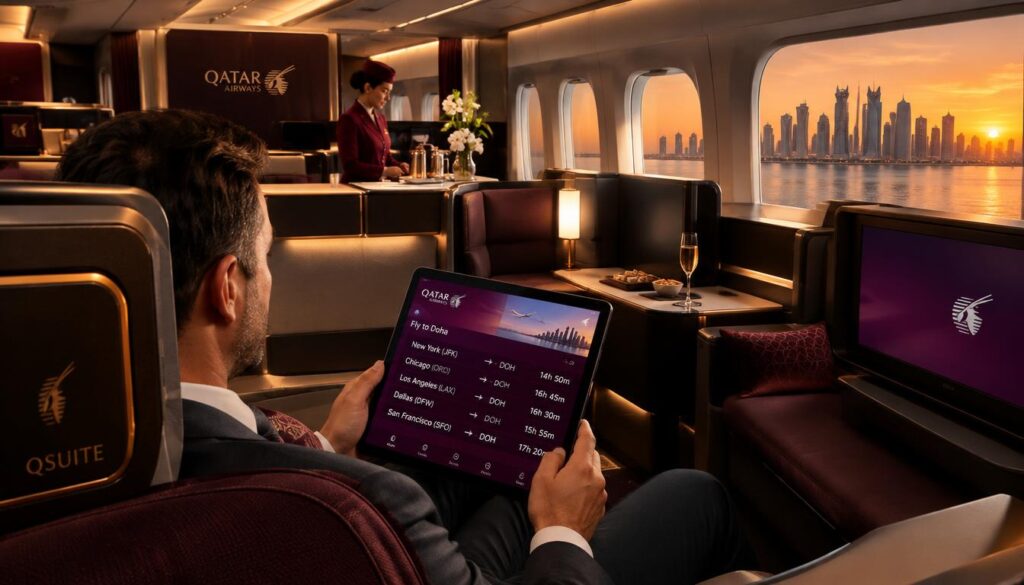
The reported Qatar Airways Qsuite award rate is 70,000 Avios one-way from the listed U.S. cities to Doha. That rate is a reported opportunity, not guaranteed inventory.
A 2026 report listed availability from May to October 2027, with up to nine seats. Current seats can differ by date and route.
Check Eligible U.S. Departure Cities
The listed cities are Atlanta, Boston, Chicago, Dallas, Houston, Los Angeles, Miami, New York, Philadelphia and Washington, D.C. Each route leads to Doha.
The reported period does not mean every flight has seats throughout those months. A search label such as “amjfk new york” may identify a New York departure, but check the actual flight details.
Compare the Award With the Cash Fare
The listed one-way award costs 70,000 Avios. The same Qatar Airways business-class seats can often cost upwards of $7,000 for a one-way cash reservation.
Whether the award is cheap depends on how you value Avios and the cash fare available for your dates. Compare the full cash price with the points and required taxes.
Check the live award calendar, taxes and seat count before you transfer points or book. Confirm live availability and the complete taxes-and-fees total for the dates you can travel.
Are Two-for-One Business-Class Fares a Real Saving?
A companion fare saves money only when its rules fit both travelers’ dates and itinerary. The two-person total shows whether the deal works.
Both passengers usually need to travel together on the same itinerary and fly the same legs. The second traveler’s base fare may be free or heavily discounted.
Taxes and airport fees still apply to both passengers. A low second base fare does not make those costs disappear.
Some promotions require a Saturday-night minimum stay or limit the trip to one month. These limits can rule out a fare that first looks attractive.
Some companion-fare promotions come out 6 to 11 months before travel. That window can help travelers who already know their dates, but it may not fit a last-minute trip.
Compare the total for both passengers against two ordinary tickets. Include fees, dates and every itinerary restriction in that comparison.
Compare the final two-person total, not just the second traveler’s base fare.
Which Airlines Offer the Widest Business-Class Seats?
Among these reported examples, Singapore Airlines has the widest business-class seats, at approximately 28 to 30 inches on aircraft such as the Airbus A350 and Boeing 777. Width alone does not settle comfort.
Singapore Airlines leads these examples by reported seat width. Actual seats can differ by aircraft and cabin layout.
Compare Reported Seat Widths
| Airline or seat | Reported width | Aircraft or cabin context |
|---|---|---|
| Singapore Airlines | Approximately 28-30 inches | Long-haul Airbus A350 and Boeing 777 |
| Qatar Airways Qsuite | Typically around 21-22 inches | Qsuite business-class cabin |
| Air France | Generally 21-23 inches | Long-haul business class |
| Cathay Pacific | Typically around 20-21 inches | Business-class seats |
By reported width, Singapore Airlines stands out among these four examples. The measurements are typical or approximate, not promises for every aircraft.
Check the Aircraft and Seat Layout
Seat shape, privacy, aisle access and aircraft configuration also affect comfort. A wide seat may have a layout that does not suit how you prefer to rest.
Some cabin designs give each traveler direct aisle access, while others place seats in different positions. A premium economy class seat has a separate cabin and should not be compared as though it were the same seat type.
Check the aircraft and exact seat map for the flight number before choosing a seat for comfort.
How Should You Compare Stopovers and Fare Rules?
A lower fare through Reykjavik Keflavik may require a longer itinerary than a nonstop option. The time cost matters alongside the ticket price.
Compare the total travel time, connection length and fare value before choosing. A low price does not make every connection practical.

Weigh Connection Time Against the Fare
JFK-MAD and BOS-LHR itineraries can connect through Reykjavik Keflavik. Some JFK-MAD options instead connect through Munich or Casablanca.
For a “stop reykjavik keflavik,” check how long you wait between flights and how much total time the trip takes. A connection can lower the fare but add hours to your journey.
Search results may display “york john kennedy” or “new york john” beside JFK routes. Labels such as “pmjfk new york” and “amjfk new york” can point to different departure times.
Confirm Changes, Refunds and Ticketing
A connection on one ticket differs from buying separate tickets for each flight. Review the operating carriers and the rules that apply to each leg.
Check changes, refunds, baggage and seat selection for the exact fare. Ticket conditions and change rights depend on the fare rules and carrier.
A stopover is an ordinary connection choice, not permission to abandon a ticketed leg. Read the fare conditions for every ticketed leg before paying.
What Are the Risks of Hidden-City Ticketing?
Hidden-city ticketing means booking beyond the stop where you intend to leave the journey. The apparent saving can put the rest of the ticket at risk.
Skipping one segment cancels all later flights on the same ticket. The practice is legal, but it violates airline contracts of carriage.
Checked baggage generally travels to the ticketed destination, not the layover where you plan to leave. On a long layover, you may ask whether the airline can short-check a bag.
Short-check rules vary by flight, and a request does not ensure the bag will be available at the stop. Flights United or other carriers may apply different rules to each itinerary.
Skipping a segment can cancel later flights on that ticket, so the tactic only avoids that result on a one-way ticket or the final return segment. That limitation does not make hidden-city ticketing a routine saving method.
Hidden-city ticketing can cancel the rest of a ticket. Checked baggage usually continues to the ticketed destination.
Never rely on a short-check request to protect a later segment or guarantee that baggage will be available at the layover.
How Do You Confirm the Fare Before Booking?
Before booking, verify that every segment, cabin and fare condition matches the trip you intend to take. Small details can change the value of a ticket.
A flexible booking option helps only when its exact fare rules allow the change you may need. One-way, round-trip, multi-city and open-jaw trips suit different plans.
Use this four-item check before paying:
- Verify passenger names and travel dates.
- Confirm the cabin and operating carriers on every segment.
- Check baggage and seat-selection inclusions.
- Read change and cancellation terms.
Flight attendants do not control a traveler’s right to a free upgrade. Airlines decide upgrades based on available seats and their eligibility and priority rules.
We can help compare fares and choose a route that fits your plans. Contact us to compare options or ask about completing a booking.
Compare the final itinerary and its conditions, then book the option that fits your dates and budget.
Conclusion
A strong business-class deal balances the fare with the itinerary and the flexibility you actually need. The lowest displayed price may not suit your route, cabin or ticket rules.
We can compare business-class tickets for your trip and help you weigh the options that fit. Share your departure city, destination and dates with us to compare suitable fares and book.
Compare the available routes for your dates and book the option that fits your trip.