Private jet charter prices can start with a one-hour flight billed as two hours under an operator’s daily minimum. A charter quote is built around the aircraft and itinerary, so the hourly figure alone does not tell us what the trip will cost.
When we compare private air travel, the aircraft, itinerary, availability, billable flight time and trip logistics all shape the price. Billable flight time is the flight time used to calculate a charter charge, which may include taxi time and be subject to a daily minimum. We can use clear questions to sort out what a quote covers and how the travel experience may change with different aircraft or schedules.
Key Takeaways
- Compare quotes for the same route, dates and passenger count.
- Check billable flight time and any daily minimum.
- Separate the aircraft rate from added trip expenses.
- Match aircraft size and range to passengers and baggage.
- Ask which charges are optional or may change.
We can compare options more fairly when each quote covers the same route, dates, passenger count and trip charges.
Private Jet Charter Prices by Aircraft Type
In 2026, listed U.S. charter rates span $2,300-$23,000 per hour, with VIP airliners at the upper end. Aircraft category shapes the rate, but each operator may use a different rate card and billing basis.
For standard jet categories, listed rates run from $2,300 to $17,000 per billable flight hour. VIP airliners range from $18,000 to $23,000 per hour. These charges cover the whole aircraft, not a seat for each passenger.
Hourly rates are a starting point, not a per-seat fare. Compare the same aircraft category and billable-time rules.
| Aircraft category | 2026 Paramount listed rate | 2026 Jettly range where available | Typical mission |
|---|---|---|---|
| Turboprop | $2,300-$3,500 | $1,500-$4,000 | Short regional trips |
| Very light jet | $2,900-$3,400 | $2,000-$4,500 | Short trips, 3-4 passengers |
| Light jet | $3,750-$4,200 | $2,500-$6,000 | Regional trips, small groups |
| Midsize jet | $4,700-$5,500 | $3,500-$8,500 | Longer domestic routes |
| Super midsize jet | $6,200-$7,500 | $7,000-$12,000 | Longer nonstop flights |
These 2026 listed aircraft rates come from one rate card, not a standard market price. Other typical 2026 ranges put turboprops at $2,500-$3,500, very light jets at $3,000-$4,000, light jets at $4,000-$5,500, and midsize jets at $5,000-$6,500 per hour.
Those typical estimates place super midsize jets at $6,000-$8,000 and heavy jets at $8,500-$13,000 or more per hour. Other published ranges are wider: ultra-long-range jets may run $15,000-$28,000 or more, while heavy jets may reach $20,000 or more.
Small-plane guides may show piston aircraft at $300-$600 per hour and turboprops at $1,000-$2,000. Such figures use different aircraft and pricing methods, so they are not directly comparable with every jet charter rate.
Treat the hourly range as a first comparison, then check what each quote counts as billable time and which trip expenses it includes.
What Do One-Way Private Jet Trips Cost?
A short regional one-way trip can start near $6,000, while a transcontinental or international itinerary can cost tens of thousands of dollars. Route and aircraft both shape the estimate, and the stated price may include different charges.
Check whether a route estimate is all-inclusive, tax-and-fee inclusive, or only a base aircraft cost. The examples below use distinct pricing bases, so their totals should not be compared as if they included the same items.
| Route | Aircraft category | One-way starting estimate | Figure basis |
|---|---|---|---|
| Miami-Nassau | Turboprop | Around $6,000 | All-inclusive |
| Tampa-Boston | Not specified | $14,500 | Tax-and-fee inclusive |
| New York-Miami | Light jet | $17,000 | All-inclusive |
| New York-Los Angeles | Super midsize jet | $40,000 | All-inclusive |
| New York-London | Super midsize jet | $75,000 | All-inclusive |
In Florida, 2026 Tampa estimates including taxes and fees start at $5,900 for Naples, Miami and Key West. The Tampa one-way estimates rise to $7,900 for Atlanta, $8,200 for Nassau, $10,800 for Washington, DC, $12,600 for New York and $14,500 for Boston.
California routes show a similar spread. In 2026, a Los Angeles-Las Vegas light-jet trip was estimated at $6,000-$9,000, while a New York-Los Angeles super midsize trip started at $40,000 all-inclusive.
New York to Miami estimates range from about $12,000-$16,000 for a light jet under off-peak dates and minimal repositioning assumptions. Another all-inclusive estimate starts at $17,000. New York to Toronto estimates run $11,000 on a turboprop, $13,000 on a very light jet and $14,500 on a light jet.
A Miami-Opa-locka to Teterboro midsize or super midsize aircraft estimate is $12,500-$28,000 before added charges. A Van Nuys-to-Teterboro super midsize estimate is $31,500-$49,500 for the base aircraft alone.
Airport pairing, aircraft choice, date and repositioning can change a quote, even for the same city pair. Before treating any route figure as a budget, verify whether it is a base aircraft estimate or includes taxes and trip fees.
How Is Billable Flight Time Calculated?
A one-hour flight can be billed as two hours when an operator’s daily minimum is 2.0 hours. Billable flight time is the flight time used to calculate a charter charge, and it may include taxi time.
Many operators set a 2.0-3.0-hour daily minimum, so a short flight may cost more than its time in the air suggests. A 2026 billing example uses about 0.2 hours of taxi allowance per leg.
For example, a flight that spends one hour in the air does not always produce one billable hour. The operator may add taxi time, then apply a daily minimum to the trip.
Minimums also differ by aircraft. Light and midsize jets commonly have a 2.0-hour daily minimum, while large and VIP jets may have a 2.5-3.0-hour minimum.
Some operators apply a short-leg fee to segments under 60 minutes. That fee can affect brief hops, especially when the aircraft must still meet a daily minimum.
There is no flat daily price for a private jet. A day’s cost follows the aircraft rate and billable hours, subject to minimums and trip-specific charges.
Ask whether the minimum applies per day, per leg or to the complete itinerary before comparing short-trip quotes.
What Does a Charter Quote Include?
A quoted hourly rate may cover the aircraft, crew, fuel and insurance without covering every trip expense. Added charges can raise the final price beyond the flight-time calculation.
Taxes, crew overnights and airport fees typically add 10%-35% to U.S. trip flight-time costs. Another 2026 planning estimate puts total trip costs 20%-40% above an hourly-rate calculation after taxes, airport charges, crew expenses and positioning.
| Charge | Typical amount | Billing unit | Usual quote treatment |
|---|---|---|---|
| Crew overnight | $200-$600 | Per crew member, per night | May be added |
| Landing and ramp fees | $150-$2,000+ | Per visit | May be added |
| De-icing | $1,500-$12,000+ | Per event | As incurred |
| Premium catering | $600-$2,000 | Per order | Often optional |
Aircraft rates often include the aircraft, crew, fuel, standard fuel surcharges and insurance. Government taxes and trip logistics may be added separately to the final quote.
Positioning and crew overnights can also add costs. Catering, ground transport and de-icing may be optional or charged as incurred, depending on the trip and conditions.

The 10%-35% and 20%-40% uplifts are different planning estimates, not universal surcharges. Compare an itemized all-in total, and confirm which variable charges can still be added after booking.
Which Factors Change a Private Jet Quote?
Two travelers on the same city pair can receive different quotes when their aircraft, schedule or pickup logistics differ. Passenger needs and aircraft location can shift the price before the flight begins.
Aircraft size, route, date and repositioning are among the main factors that change a quote. A larger cabin may fit more passengers and bags, but it can raise the aircraft cost.
Aircraft choice, passenger count and baggage
Passenger count affects which aircraft can carry the group comfortably. A full cabin and heavy baggage load may require a larger aircraft than the passenger total alone suggests.
Range also matters. A smaller jet may need a fuel stop on a longer route, adding time and changing the trip plan.
Aircraft type, distance, refueling, airport fees, crew, taxes, repositioning, passenger count and luggage can all affect pricing. We should share the full passenger and baggage load to find a useful match.
Route, positioning and travel dates
The departure airport matters because the aircraft may not already be there. A repositioning leg is the aircraft’s flight to or from a pickup location without charter passengers.
Crew schedules, airport choice and the route can add logistical needs. Booking within 14 days or traveling on peak dates can tighten availability.
Thanksgiving, Christmas, New Year holidays, Super Bowl weekend and Art Basel Miami can bring 10%-20% premiums. Booking 30-60 days ahead gives travelers a wider aircraft selection.
- Aircraft and cabin fit
- Passenger and baggage load
- Aircraft location before pickup
- Date or schedule flexibility
Share passenger count, baggage, departure airport and date together when requesting comparable options.
Which Taxes and Airport Fees Should We Expect?
U.S. domestic charter segments carry a 7.5% Federal Excise Tax, plus a per-passenger segment fee. Domestic flights in 2026 have a $5.30 segment fee for each passenger.
International flights to or from the United States also carry a $23.40 per-passenger head tax, plus applicable local taxes. Customs, immigration and agricultural charges may apply on arrival.
The listed U.S. international-arrival charges include a $7.61 customs user fee, about $7.00 for immigration and $3.84 for agriculture per passenger. Alaska and Hawaii passenger tax is listed at $11.70.
The NBAA federal excise tax guide explains how federal taxes apply to domestic passenger air transportation, including segment fees and the international head tax.
Airport charges depend on the airport and aircraft. 2026 estimates list landing fees at $100-$1,500 per flight and handling fees at $100-$800 per flight.
- Federal excise tax
- Per-passenger segment fee
- Airport landing fee
- Airport handling fee
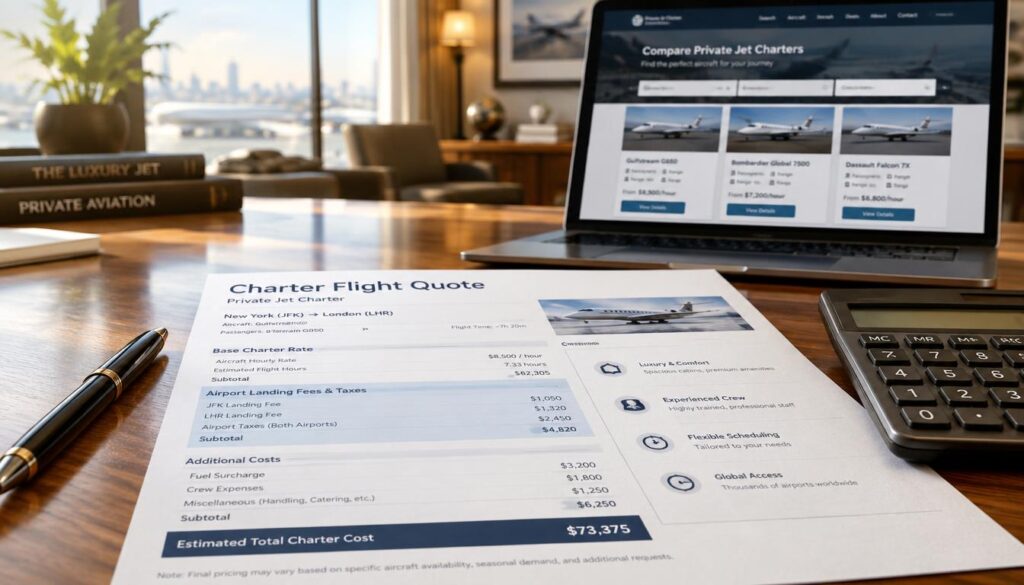
An international itinerary can carry additional route-specific government charges. Ask the quote provider to show each tax and airport charge separately, especially for international or multi-stop trips.
How Can We Reduce the Cost of a Charter?
An empty leg can be substantially cheaper, but the traveler has to fit the aircraft’s repositioning schedule. Flexible travel can open up lower prices, though the route may not match our plans.
Empty-leg flights may cost 25%-75% less than standard charter pricing, but the discount is not guaranteed. Some listings may show deeper cuts, yet the route and dates still need to work.
Use empty legs when the itinerary is flexible
An empty leg follows an aircraft’s repositioning route and schedule. It may not suit fixed dates, preferred airports or a return plan.
A 2026 search found New York-Los Angeles empty-leg flights within a one-week window, but the example did not show a price. A discount is only useful when the timing and destination fit.
Flexible scheduling and empty-leg price reductions can lower costs by 25%-75% in some cases. We should treat that range as a possibility, not a promise.
Match aircraft and schedule to the trip
Choose an aircraft that fits the passenger group and baggage without paying for unused cabin space. A nearby airport may also reduce the aircraft’s positioning needs.
Flexible departure times can widen the available choices. A round trip may also work better when the same aircraft and crew can support both legs.
- Check empty-leg availability.
- Compare flexible dates and times.
- Ask whether a round trip or nearby aircraft reduces logistics.
Choose a standard charter when schedule control matters more than the chance of a lower empty-leg fare.
How Should We Use a Cost Estimator and Compare Quotes?
A cost estimator is most useful when we enter a real route, travel date, passenger count and return-flight plan. Accurate inputs help produce a more useful starting estimate.
An online estimate is preliminary, not confirmation of aircraft availability or a final quote. A real itinerary gives the pricing tool better details to work with.
Build a useful estimate
Enter departure and arrival airports, travel dates, preferred times and passenger count. Include whether we need a return flight, since that changes the itinerary.
The Jettly Private Jet Cost Calculator describes real-time pricing based on a global network of operators. A calculator can help with early budgeting, but aircraft availability can change.
For Texas, a 2026 Houston-to-Los Angeles estimate is $35,000 for a midsize jet. Florida and California route examples appear in the route section, including trips from Tampa and Los Angeles.
Compare like with like
Two quotes are easier to compare when they use the same airports, dates, passenger count and aircraft category. We should also compare what each quote includes.
- Aircraft category and operator
- Billable time and daily minimums
- Positioning and taxes
- Included versus optional charges
A New York-to-Toronto one-way estimate ranges from $11,000 to $14,500 across turboprop, very light and light jets. The aircraft category changes the price even on the same route.
Request a written quote for the exact itinerary before treating an online estimate as bookable.
Is Chartering Cheaper Than Owning a Jet?
Chartering avoids taking on an aircraft’s ongoing ownership responsibilities, while ownership may suit a traveler with substantial, consistent use. Annual use and the aircraft we need shape the comparison.
Charter charges follow individual trips, while owners pay ongoing costs even when the aircraft is not flying. Ownership brings maintenance, fuel, storage, staffing and insurance needs.
Compare trip-based charter with ownership costs
Charter can be a practical choice when we fly occasionally or need different aircraft for different trips. We pay for a service rather than managing an aircraft year-round.
Frequent use may change the math, especially when we need the same aircraft type on a steady schedule. Annual travel patterns matter more than one trip’s price.
What aircraft sale listings can and cannot tell us
Two listings show why asking prices describe individual aircraft, not a market-wide range. One 2002 aircraft, serial number 550B-1033, listed at $1,295,000 with 4,114.2 total hours.
That listing was updated October 14, 2026. Another aircraft, from 2013 with serial number 60-428, listed at $3,995,000 and 1,709.2 total hours.
The second listing was updated October 18, 2026. Model, year and recorded hours affect each listing, while purchase price excludes the full cost of ownership.
The lowest listing price alone cannot identify the cheapest suitable aircraft to buy. Compare annual charter spending with purchase, operating, staffing, maintenance and storage costs before deciding.
Which Aircraft Category Fits Our Route and Group?
Start with the number of passengers and bags, then check whether the aircraft can cover the route without a fuel stop. Cabin fit and range help narrow the category.
Passenger capacity and range are planning guides, not guarantees for a specific flight. Model, baggage load, winds, routing and airport conditions can change what an aircraft can do.
Very light jets typically carry 3-4 passengers and have a 1,125-1,550-nautical-mile range. Light jets typically fit 5-7 passengers and cover 1,495-2,165 nautical miles.
Super midsize jets commonly fit 7-9 passengers, with a 2,700-4,018-nautical-mile range. Ultra-long-range jets may carry 12-14 passengers over 5,200-7,750 nautical miles.
Turboprops can suit short regional trips with 4-8 passengers. Large jets can serve longer flights and groups of up to 13 passengers.
A smaller group on a short route may not need a large cabin. A larger group or longer nonstop mission may need more space and range.
An undersized aircraft can require a fuel stop, adding time. An oversized aircraft may cost more without giving the group a useful benefit.
Choose for the real passenger and baggage load, then confirm nonstop capability for the specific aircraft.
Ask the operator to confirm usable passenger capacity, baggage limits and nonstop capability for the specific aircraft.
Conclusion
A realistic charter budget starts with the full itinerary, not a single hourly rate. The aircraft rate is only one part of a trip’s cost, and quotes are comparable only when they cover the same route and inclusions.
Our next step is simple: prepare the dates, airports, passenger count, baggage and return needs. Then request an itemized quote for the exact trip.
Gather your route, dates, passenger count and baggage needs, then compare itemized quotes for the same trip.