A successful U.S. trip needs a travel guide that matches our places, available time, and travel style. The country rewards planning around regional distances, trip length, interests, and season.
We can use this resource hub to research destinations, shape a route with itinerary tools, plan national park visits, and prepare for daily needs. No single plan suits every traveler, so we should choose what fits our goals.
Start with places that matter to us, then check how much time we have and how far apart those places are. A focused trip often leaves more room for the experience we came to find.
Key Takeaways
- Choose a region that fits our trip length.
- Use current destination details to shape plans.
- Group nearby stops to save time.
- Check park access rules before setting out.
- Leave room for meals, rest, and local discoveries.
Choose one region as the trip’s anchor before adding distant stops.
Which U.S. Travel Guide Resources Should We Use?
For a broad U.S. overview, start with destination websites and regional visitor guides, then add a book when we want deeper context or handy maps. Use official pages for current details, and use books for background and ideas.
Use official pages for current details, and use books for background and ideas.
Printed guidebooks and destination visitor guides
A travel guide can mean a book, an author such as Rick Steves, or an in-person local guide. A travel guide book can offer facts, maps, and tips in one place.
Lonely Planet covers most countries in the Americas, with broad facts, low- and mid-budget listings, and on-the-ground tips. Rick Steves focuses on fewer destinations, with deeper detail and research updated in person with research partners.
Rick Steves says most guidebook titles are updated every three or four years. He advises readers to check a book’s publication date before buying, since details can change between editions.
Print can make maps and quick lookups easier, while ebooks let us carry many titles without adding weight. The best format depends on whether we value paper maps or a lighter bag.
Tourism boards offer visitor guides in print and digital formats. These guides may include itineraries, maps, attractions, places to eat and stay, and discounts.
Readers comparing destinations and resort styles can also explore all-inclusive vacation options as one part of trip planning.
Websites and apps for current details
Travel guide websites run by local tourism offices can help us find current visitor information. The National Park Service offers official park maps and trip-planning details through its park planning pages.
Use those pages for park information, not a tourism-board guide. A visitor guide may cover local events, attractions, and discounts, while the park service covers its own sites.
Lonely Planet’s Best in Travel 2027 lists 50 places. It is an editorial list, not an objective ranking of the world’s best destinations.
Printed and digital resources serve different needs, so we can use both. Check a guidebook’s publication date before relying on time-sensitive details.
How Can We Build a Practical U.S. Itinerary?
A workable U.S. itinerary usually groups nearby stops instead of trying to cross several regions in a few days. Keep the route local when time is short, and leave space for delays and rest in every full day.
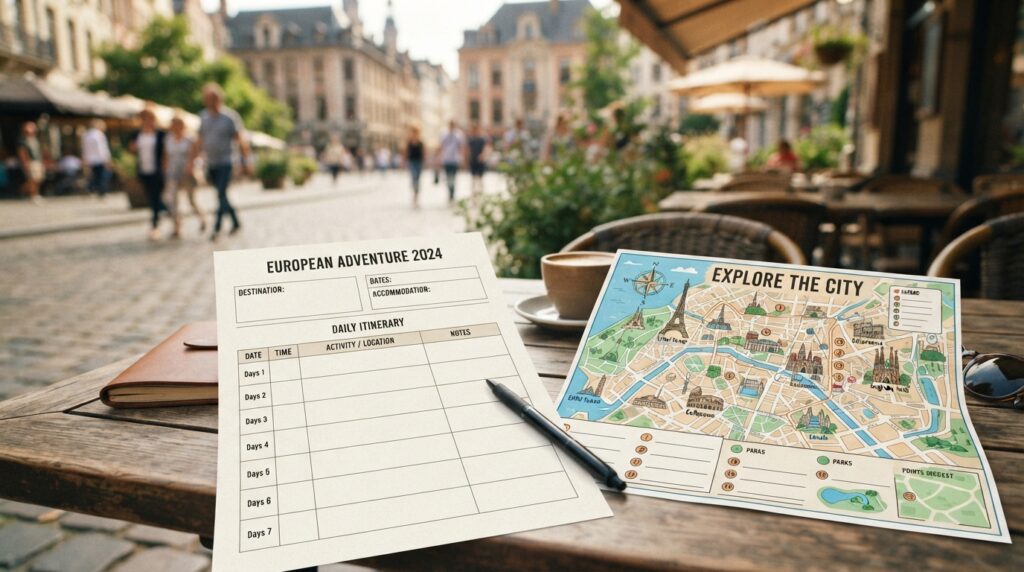
A travel itinerary template should track each day, overnight location, transport, booked activity, and backup plan. This simple record helps us see when a route asks too much of one day.
- Choose a region and trip length.
- Group nearby destinations together.
- Leave open time for meals and delays.
- Confirm opening conditions and reservations before travel.
Washington, D.C., and New York City show why nearby sights work well together. In Washington, we can group museums and monuments by area, while a New York City day can focus on one part of the city.
A travel guide app can store plans and maps, but we should check which features cost extra. Tripomatic’s Washington, D.C. city-guide app is listed as free with in-app purchases.
Its features include day-by-day itinerary planning, offline maps available as an in-app purchase, and a downloadable PDF guide. The listing does not mean every feature comes free with the app.
Distance and transit can make a route look shorter on a map than it feels during a full day. A long ride, a transfer, or a slow walk between stops can use time we expected to spend sightseeing.
We can also compare a planned day with the way we want to travel. A packed schedule may suit a short city visit, while a slower pace leaves room for a local find.
Keep one unscheduled block in each full day for delays, rest, or an unexpected find.
How Do National Park Fees, Passes, and Reservations Work?
Non-U.S. residents planning visits to multiple participating federal recreation sites can use the $250.00 annual pass for one year of entrance and standard day-use amenity fees. The America the Beautiful pass is a clear choice for multiple visits, while a single-park fee may suit one visit.
The 2026 pass covers participating sites managed by six federal agencies. Depending on the fee type, it covers one private-vehicle fee or four per-person fees.
Pass options and nonresident entrance fees
The participating agencies include the National Park Service, U.S. Fish & Wildlife Service, U.S. Forest Service, Bureau of Land Management, Bureau of Reclamation, and U.S. Army Corps of Engineers.
In 2026, the digital pass from Recreation.gov can be saved to a phone and used immediately. A physical pass ordered from the USGS Online Store may take up to three weeks to process and arrive.
The order receipt cannot replace the physical pass. Visitors can also buy or pick up a pass in person at more than 1,000 federal recreation sites.
| Purchase method | Cost | When usable or available |
|---|---|---|
| Digital via Recreation.gov | $250.00 | Immediate mobile use |
| Physical order via USGS Online Store | $250.00 | Up to three weeks; receipt not valid |
| In person at federal recreation sites | $250.00 | More than 1,000 sites |
In 2026, a $100 nonresident fee applies at 11 parks for non-U.S. residents ages 16 and over. The parks are Acadia, Bryce Canyon, Everglades, Glacier, Grand Canyon, Grand Teton, Rocky Mountain, Sequoia & Kings Canyon, Yellowstone, Yosemite, and Zion.
Most National Park Service sites are free, but some charge entrance fees. A pass covers eligible fees, but it does not replace a reservation when a park requires one.
Reservations, crowds, and visitor data
A timed-entry reservation is a booking that assigns a visitor a specific arrival window to manage vehicle access. Some parks use these bookings for traffic, while others use tour reservations for entry to buildings or natural features.
In 2026, parks typically release reservations on a rolling basis through Recreation.gov. Requirements differ by park, so check current park details before setting out.
The National Park Service recorded 323 million recreation visits in 2025, down 8.85 million visits, or 2.7%, from the 2024 record. Visitor hours totaled 1.39 billion, down 0.7%, while overnight stays fell 2.4%.
Visits count entries, visitor hours measure time spent, and overnight stays track nights in parks. These figures describe different kinds of use, not three ways to count the same thing.
Twenty-six parks, or 6% of reporting parks, set annual visit records in 2025. Of 433 National Park System units, 406 reported visitor use that year.
National parks accounted for 29% of National Park Service visits in 2025. National recreation areas made up 15%, national memorials 11%, and national parkways 10%.
The 2025 park visitation report gives more detail on yearly use. Current-year visitor data remain preliminary in 2026 and may be incomplete or not yet quality-controlled.
The National Park Service dashboard includes data from 1979 onward, and annual recreation-visit estimates cover 1904-1978. Confirm the exact park fee and reservation requirement before setting out, because a pass does not replace a required booking.
What Should We Plan for Beyond the Main Attractions?
A route is easier to enjoy when transport, meals, and access needs are planned alongside the attractions. Daily details matter, and the best travel choice depends on the route and time we have.
Plan transport, meals, and access needs alongside the attractions. The right details can shape the day as much as the sights.

Getting around between regions and cities
The United States is large, so we should compare driving, intercity rail, and flights for each route. Amtrak is one rail option, but it does not serve every route we may want.
Driving can help us reach places far from rail stations, while flights can save time between distant regions. We can compare flight routes and fare rules when a long trip includes air travel.
Travel time also includes airport transfers, road stops, and waiting for connections. A map may make two cities look close, even when getting between them uses much of a day.
Food, local culture, and daily spending
We can plan meals around local specialties and opening hours without expecting every region to serve the same food. Local markets, diners, and neighborhood restaurants can offer different ways to experience a place.
Check meal hours before building a busy day around one restaurant. Regional culture shapes daily routines, so some places may have fewer options at certain times.
Room in the budget can help us try a local dish or make a last-minute change. Travelers who prefer a resort stay can compare all-inclusive package details, including meals and other inclusions.
Accessibility and backup planning
Access needs can affect transport, lodging, and activities, so we should check details for each stop. The ADA.gov Title II rule covers web content and mobile apps provided by state and local governments in 2026.
That rule is not a blanket guarantee for every private travel service. We should ask the specific venue or transport operator about access features before relying on them.
- Check local transit and driving needs.
- Confirm meal hours and dietary options.
- Review access details with the venue or transport operator.
- Save offline directions and a backup activity.
A saved route can help when cell service drops, while a backup activity can keep a day useful after a closure. Verify access arrangements directly with the venue or transport operator before relying on them.
Conclusion
The strongest U.S. trips leave enough structure to make the days work and enough flexibility to make them memorable. A regional focus can help us spend less time crossing long distances and more time finding local experiences.
Pick one destination, check its current official visitor information, and draft the first day before booking the rest.